I gave MS Copilot a try, and this is what my trip to Albania sounded like after AI got its microchips into it. The experience described is real, and so are the videos. No AI was harmed during all of this from this point onward.
An Experience of Arrival in Albania
Travelling to Tirana, Albania via Frankfurt turned my Thursday into a whirlwind of excitement and discovery. My day began bright and early, checking in at the airport and boarding my flight to Frankfurt—a city known for its efficient airport, which truly lived up to its reputation. The layover gave me a chance to stretch my legs, grab a coffee, eat lunch and observe the steady rhythm of global travellers before making my way to the connecting gate.
The flight from Frankfurt to Tirana was smooth and filled with anticipation. As we approached Albania, the scenery shifted from bustling urban landscapes to the dramatic mountains and lush greenery of the Balkans. Landing in Tirana, I was welcomed by the warmth of spring and a vibrant energy unique to this city. Passing through customs was quick and easy, and soon I was exploring the lively streets, ready to dive into Albanian culture and cuisine.
To immerse myself in the heart of Tirana, I joined a three-hour walking food tour through the city’s bustling streets. The adventure began on Skanderbeg Square near the I Love Tirana sign, where my local guide introduced me to the history and culture behind Albanian traditions. We strolled past colourful buildings and lively cafes, stopping first at a local restaurant to sample warm soup made of a calf head and flaky byrek—a savoury pastry filled with spinach and cheese.
Continuing along, we wandered through the Pazari i Ri (New Bazaar) area and had a cup of coffee. After that, we went for an ice cream with corn juice, which was my first time trying something like that. For dinner, the guide led me to a cosy tavern tucked away in a side street, where we tried a sampling menu including, among other things, the tavë kosi, a traditional baked lamb and yoghurt dish, paired with different beans, sauces, sausages, kebabs, peppers etc. Each stop offered a unique glimpse into Albanian flavours and hospitality. The experience left me with a deeper appreciation for Tirana’s vibrant food scene and the warmth of its people—a perfect introduction to the city’s culinary delights.
A Day Trip to Albania’s Historical Heart
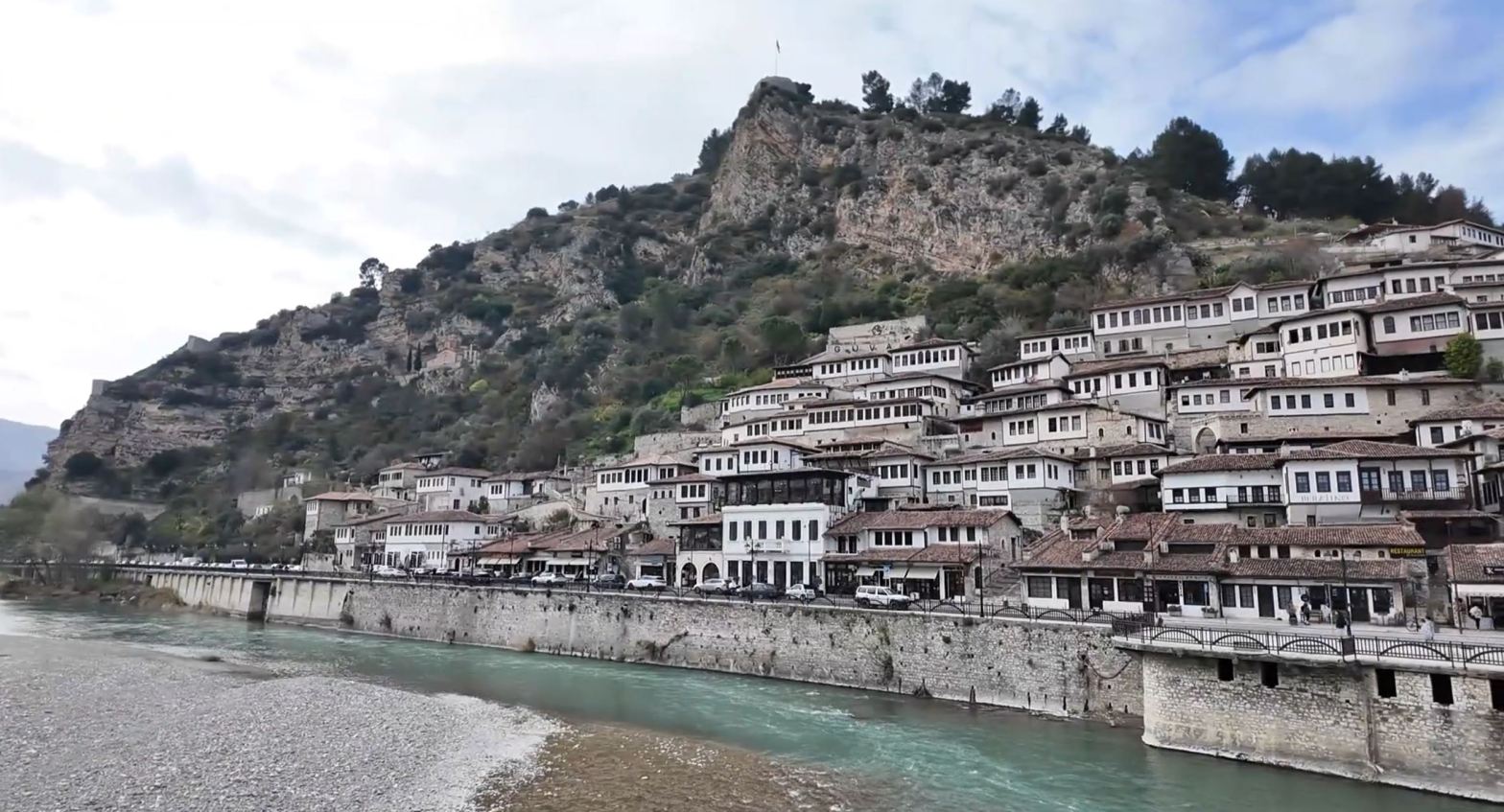
After immersing myself in Tirana’s lively food scene, I was eager to explore more of Albania. The next morning, I set out on a guided day trip to Berat—one of the country’s most fascinating UNESCO World Heritage cities, renowned for its striking Ottoman architecture and rich history. The journey from Tirana was scenic, winding through rolling hills and rural landscapes that gradually gave way to the iconic white-washed houses of Berat, nestled beneath a grand fortress.
Our first stop was the legendary Berat Castle, perched high above the city with sweeping views of the Osum River valley. Walking through the ancient stone gates, I felt transported back in time as we wandered among centuries-old churches, mosques, and vibrant local homes still inhabited by families. The castle’s walls offered breathtaking panoramas and countless photo opportunities. Inside, our guide shared stories of Berat’s “city of a thousand windows” nickname—each home’s unique window arrangement creating a mesmerising mosaic across the hillside.
After soaking in the historical atmosphere, we continued on to the charming town centre. The cobbled streets were lined with local shops and cafes, where we paused for a traditional Albanian coffee and sweet treats. The city’s relaxed pace and friendly residents made it easy to appreciate why Berat is celebrated as a living museum.
The tour also ventured to Belshi Lake, a tranquil escape located between Tirana and Berat. Surrounded by lush greenery and peaceful walking trails, the lake provided a refreshing contrast to Berat’s ancient stonework. We enjoyed a leisurely stroll along the water’s edge, watching fishermen and families picnic under the shade of willows. The serenity of Belshi Lake was the perfect finale to our cultural excursion.
Returning to Tirana as the sun set, I reflected on the day’s discoveries. The Berat UNESCO tour not only revealed the layers of Albania’s history and architectural beauty, but also highlighted the warmth and hospitality that make travelling here so memorable. From castle ramparts to lakeside tranquillity, this adventure is a must for anyone seeking to experience the heart of Albania in a single day.
Exploring the Natural Wonders Just Outside Albania’s Capital
After soaking in the urban energy and rich history of Tirana, I was ready to dive into Albania’s wild side. The Gamti Mountain hike with panoramic Bovilla Lake and canyon views promised an exhilarating escape—just a short drive from the city centre, yet worlds away in character and scenery. Early on Saturday morning, I joined a small group tour heading northeast from Tirana, winding through rural villages and green landscapes toward the towering cliffs of Bovilla Lake.
Arriving at the lake’s edge, the scene was nothing short of breathtaking. Bovilla’s emerald waters shimmered beneath steep limestone walls, offering a dramatic backdrop for our adventure. After a quick safety briefing, we started the hike up Gamti Mountain. The trail, though moderately challenging, was well-marked and led us through fragrant pine forests and rocky outcrops. Each step revealed new vistas—first the deep canyon carved by the river below, then sweeping views of Bovilla Lake stretching into the horizon.
Halfway up, we paused to catch our breath and snap photos from a cliffside viewpoint. The guide shared stories about the lake’s importance to Tirana’s water supply and the region’s unique ecology. With the sun warming our backs, we continued up the final stretch—a steep but rewarding climb that ended at the summit. From here, the panorama was pure magic: rolling mountains, sparkling water, and a sense of peaceful isolation that made all the effort worthwhile.
After descending, we circled the lake’s perimeter, exploring hidden coves and the impressive Bovilla Canyon. The area is popular with local climbers, but even for casual hikers, the sights and sounds of nature are immersive. We finished the day with a picnic beside the water, savouring fresh Albanian snacks and sharing stories with fellow travellers.
This Gamti Mountain and Bovilla Lake tour is a must for anyone seeking adventure near Tirana. The hike offers not only physical challenge and stunning scenery, but also a glimpse into Albania’s wild, untouched beauty—a perfect counterpoint to the vibrant city life. Whether you’re a seasoned trekker or just looking for an unforgettable day trip, the views and memories will linger long after you return to Tirana.
Finally in Skopje, the capital of North-Macedonia, after my overnight in Kosovo. I had arrived the night before and was ready to explore this country now.
Thursday, October 23
I had an early start because my tour to Ohrid started at 8 AM. The streets in Skopje were surprisingly empty. The guide told us that there was a national holiday because an organisation was founded during the Ottoman regime to fight for Macedonia. It also came as a surprise to the guide, which is understandable because guides usually work when all the others have holidays.
The drive took about 3 hours, during which we had to cross the longest and highest mountain range in Macedonia. The weather was great, and the autumn colours in the mountains were breathtaking. There were 7 of us in the group this time. Its interesting to see how one tour differs from another. This time, the vibe was completely different. There wasn’t that much socialising among the people as during the tour in Kosovo. The guide was not bad, but he didn’t really connect with the people either.
After parking the car on top of the hill, we started our walking tour through the town. First, a couple of churches (each cost 3 EUR), which I couldn’t care less about. Instead, I enjoyed the views over the town and Lake Ohrid. Some of our group went to the churches as good tourists should, so there was some waiting for me to do. I was looking forward to the fortress on top of the hill, but it turned out to be a small disappointment. For another 3 EUR, you could walk the walls and enjoy the views, which I did this time. Then it was time to walk down the hill into the town itself. It got better with each step. The narrow streets and beautiful vistas made everything better. The town is also famous for the pearls. According to the BBC, on the shore of one of Europe’s oldest lakes, two families have been guarding a tightly held treasure for 100 years: fish pearls. Straddling the border of North Macedonia and Albania, Lake Ohrid is one of the oldest and deepest lakes in Europe. A cultural and natural Unesco World Heritage site, the lake’s emerald-green waters are home to 212 known species of endemic plants and animals. One of them, the plasica fish, is an essential ingredient used to make one of the area’s most famous treasures: the Ohrid pearls. For nearly 100 years, there have only been two families that have known how to produce the Ohrid pearls: the Talevs and the Filevs. Unlike regular pearls, Ohrid pearls are made from shells, which are ground and made into balls of various sizes by adding at least eight coats of a secret emulsion, giving them their characteristic shine.
This is the town where Macedonian people like to spend their holidays. The town seems to be made for tourists with all the restaurants along the lakeside promenade. Before lunch, we had a chance to go for a private boat ride along the coast and see the town from another angle. I passed up the chance to dine in one of the more expensive restaurants on the promenade and had a pizza instead. That left me some time to enjoy the lake some more before our 3-hour drive back to Skopje.
Friday, October 24
I had a tour planned to the Millennium Cross and Matka Canyon at 9:30. It was raining earlier, but by 8 AM the rain had stopped, and the sun was out. It was going to be one of the warmest days here. I was early as usual, but from the very beginning, everything was off. I didn’t share the guide’s vibe, and it all concluded with our values clashing when I couldn’t really be called friends with some people currently waging war and declined the chance of sharing a minivan with them. So I was sent away from the tour because of that. First time for everything. Lesson learned from here is that if I’m willing to have my mouth shut and not have an opinion (which is not happening), then from now on I should prefer private tours.
So I found myself a private tour. That left me some hours to walk through the Old Bazaar and the fortress by myself first. The Old Bazaar was a prime example of how everybody is selling the same crap that everybody else is selling. There were streets full of stores selling “jewellery”. Where are the people who would need so much? Behind the Bazaar was another bazaar selling everything else from garden hose connectors to foodstuffs. I will probably go back there tomorrow with a guide to make more sense of all this.
My private tour guide Boris, picked me up from Macedonian Square and we drove directly to Matka Canyon. This is a rather spectacular nature site in a country full of mountains. I left Boris to wait in the parking lot and followed the trail all the way to the boat rentals. Yes, there are several boats going along the canyon. Some are making shorter trips and some longer. I chose the longer one for 500 MKD, which took me to the Vrelo cave. My first expectation was that the boat would get into the cave as they do with some seacaves along the coast. This time, however, we needed to climb up the stairs and then down into the cave. According to Wikipedia, Vrelo Cave has many stalactites, including a large one in the middle of the cave known as the “Pine Cone” due to its shape. There are two lakes at the end of the cave, with one larger than the other. The smaller lake is 8 metres at its longest length and 14.92 metres in depth at its deepest point. The larger lake is 35 metres at its longest length and 18 metres at its deepest point. Though the exact depth of the cave is unknown, it is believed to be among the deepest in Europe and/or the world.
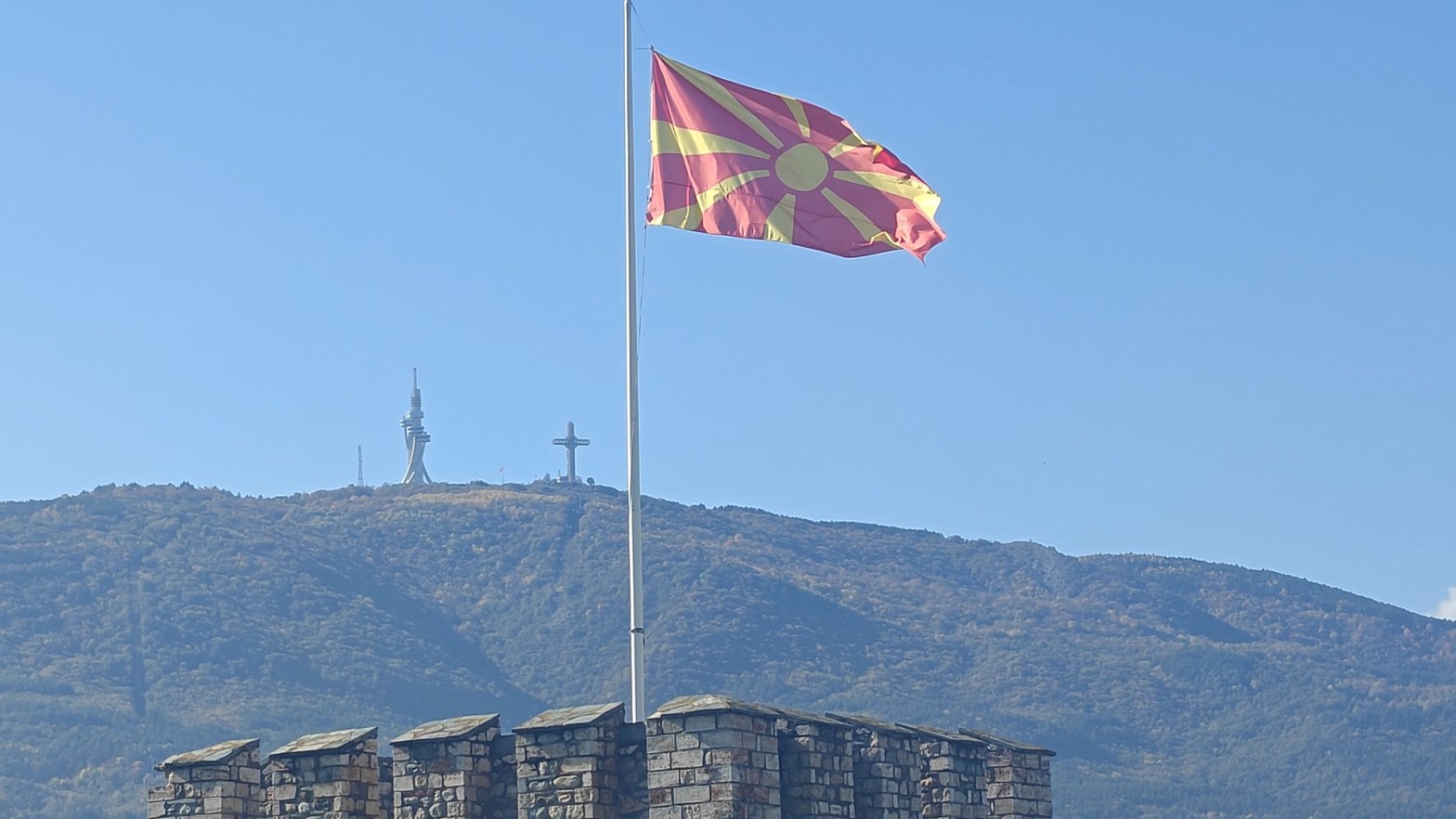
Our second destination was the Millennium Cross, which is a 66-meter-tall cross on a mountain next to Skopje. Built in 2002, it’s one of the tallest crosses in the world. It was constructed to serve as a memorial for 2,000 years of Christianity in Macedonia. Now it’s a landmark with the best observation point to see over the panorama of Skopje. It’s seen from everywhere…even from my apartment, and it’s well-lit even in the night. In order to get there, you need to drive first up the mountain. From the parking lot its just a few steps to the cable car station, which will take you the rest of the way. There were a lot of people at the top enjoying the view and walking around. There was almost no wind on top of the hill, so I had to wait for a long time to get the flag flying enough for a picture. But I wasn’t in any hurry because the cable cars had stopped working. They seem to work for 30 minutes and then rest for 30 minutes. So my timing had been very good.
After I got dropped off at my apartment, I had a chance to rest a bit, try the Wolt food deliveries (which were way quicker than I had expected), and after writing this bit here, I’m ready to go and find some live music tonight. I don’t know how many people there are out and about, as Skopje is a place where people come to work during the weekdays and then drive back home for the weekends. We’ll see.
P.S. It didn’t go that well. I had chosen an Irish pub on the riverside because many portals recommended it and because there was live music. It might have been my worst Irish pub experience so far. They didn’t have Guinness on the tab, but only in a can. Which wasn’t cold enough, and which they didn’t even bother to pour out for me. The music included some classical rock songs, which I didn’t get to hear much, because they started half an hour later than planned, and by that time I had run out of the “Guinness” and couldn’t stand a minute more inside the smoke (because people still smoke inside in Macedonia).
Saturday, October 25
I had two tours to look forward to. The first was a food tour starting at 11:30, so it was a chance to have lunch and explore the local food scene. It turned out to be a brand new tour, and I was officially the first paying customer. The tour started from a local farmers’ market with some bureks with cottage cheese and spinach. After that, we walked to the so-called bohemian quarter to visit a cafeana. These are local restaurants, where people like to hang out as long as they are not thrown out, basically. We had a selection of different vegetable spreads with white cheese and white bread. It was delicious. Our next stop was a rakija bar. Locals like their rakija after appetisers, so it was a good timing. The selection of different flavours is mindblowing. The guide had pre-selected a few combinations, so I had a chance to taste three different flavours. My favourite was the grape, which is the Macedonian speciality, but the plum and apricot were not bad either. From the bohemian quarter, we walked through the city park to the riverside and had some kebab sticks with onion and pita bread in a cafeana overlooking the river. The last stop was in the old town, where I had a chance to have a dessert in the form of an oversized macaron with crème filling. So in three hours, I had managed to have lunch and got to understand the people and city a little better.
My second tour started at 4:30 from the Macedonian square. It was a city walking tour that I originally planned to have the day before. I didn’t expect much, but got a show that was a perfect ending to my visit to Skopje. I think I have never grinned so much during a tour. The guide was full of facts, information and good humour. Plus, I really envied his voice. Not only was it strong enough to be heard over the street noise, but it was also probably heard one street over. He was obviously very intelligent, well-travelled and able to convey it in a clear way. Here are some things worth repeating. Macedonia and Skopje have been through a number of different kingdoms and empires. One of the longest influencers was the Ottomans. Skopje was destroyed many times during the last century. One of the most profound destructions took place in 1963, when an earthquake levelled pretty much the whole city. So everything you see in Skopje is built after that. The rebuilding was a great example of solidarity between the countries, which funded the building in the next few years. The locals know exactly what was built by the soviets, Americans, Bulgarians, designed by Japanese etc. And remember that it was the height of the Cold War back then. Then the Skopje 2014 project happened. It’s one of the most controversial things I have ever heard happening in a modern city. You can read more about it in Wikipedia (https://en.wikipedia.org/wiki/Skopje_2014), but in short, it was decided to give Skopje a more monumental and visually pleasing image. It cost 80 – 500 million euros to 1 billion euros (nobody knows). They built a countless number of statues (nobody knows how many, but people have been trying to count them and ended up with different numbers between 360 and 380), bridges over the river where you don’t really need them and covered the facades of some buildings with a facelift. It is now known that it was one big corruption case, which has resulted in crumbling buildings and rusted statues only a decade later. It’s what you can call kitsch with poor building quality, “marble” made of concrete and “bronze” made of some rusting metals. The locals are really unhappy with the result. The local municipality elections are ignored by the locals due to hopelessness; the streets during the elections are full of garbage due to some political games, and Macedonians have had to make several “compromises” with the Greeks in order to join NATO and be part of the EU one day. Because you can’t have any ongoing political disputes with your neighbouring countries, like Greece.
My main objective was to explore North Macedonia during this trip, but as Kosovo was just next door, I decided to spend an overnight in Kosovo as well.
Tuesday, October 21
Flight to Skopje took me first through Frankfurt as usual. Arrival time was 14:15 in the afternoon, which was very convenient. I had asked welcomepickups.com to pick me up from the airport at 3 PM, but I managed to get through customs and everything already by 2:40. My driver was waiting for me and was just a WhatsApp message away. So by 3:20, I was at my accommodation in the city. I quickly let myself in through 3 different coded doors and repacked my backpack. I planned to leave my suitcase stay overnight by itself, and I planned to find my way to another country altogether. Thanks to Rome2Rio I had managed to find that there should be a train from Skopje to Prishtina in Kosovo at 4:30. I stayed only 5 minutes away from the train station so I ran there and found out that there is no train but a bus that goes at 4:30. Luckily the bus station was at the same place so I just managed to buy myself a bus ticket with Amalfi Tours. The ticket cost 550 MKD (ca 10 EUR). I had made such a good time that I even had time to get a Fatih burger from a nearby kiosk and have a delicious lunch/dinner. There were only 5 of us on the bus. The border crossing went relatively smoothly. The border guards took our passports, and we didn’t even have to leave the bus. The border was only about 45 minutes away from Skopje. The whole trip was supposed to take only about 2 hours, but it took almost 3 hours. Something happened with the bus as soon as we had crossed the border, and from there we limped at a speed of ca. 60 km/h to Prishtina. But we made it. I had booked my hotel near the train station, but it didn’t really help, because the bus station was about 20 minutes away. So I walked through the city with Google Maps showing me the way. As North Macedonia and Kosovo are two different countries and not part of the EU, my data plan needed to be renewed for these few days. Using Airalo eSims is so easy nowadays, and using phones which support eSims is mandatory for anyone travelling away from the EU. But I still needed two different eSims for that. The hotel was expecting me. After a liquid dinner and a shower, I was ready to call it a night.
Wednesday, October 22
Breakfast was at 8 AM and was delicious. I had actually booked a tour from Skopje to Kosovo, which I planned to meet in Prishtina. They arrived just after 10 AM, so I had little time to look around by myself before that. The meeting was on time, and we went for a walking tour through the city centre for a few hours. There were six of us in the group. After seeing all the highlights, we got back to the minivan and continued on to Prizren. Everybody agreed that this second biggest town in Kosovo is more interesting. After parking the car, we had another nice walking tour through the town. At 2:30 was the time for lunch. The guide suggested a restaurant with traditional food, which turned out to be very good. Lots of food to share, and it cost only 12 euros. Yes, Kosovo has been using euros already from 2002, which makes everything so much easier. After 4 o’clock, we were ready to start our drive back to Skopje. The border control was easy, and two hours later, we had arrived.
One peculiarity worth mentioning in Kosovo was that every public clock on the streets of both towns was wrong. Like, way wrong. Always something 8 past something…
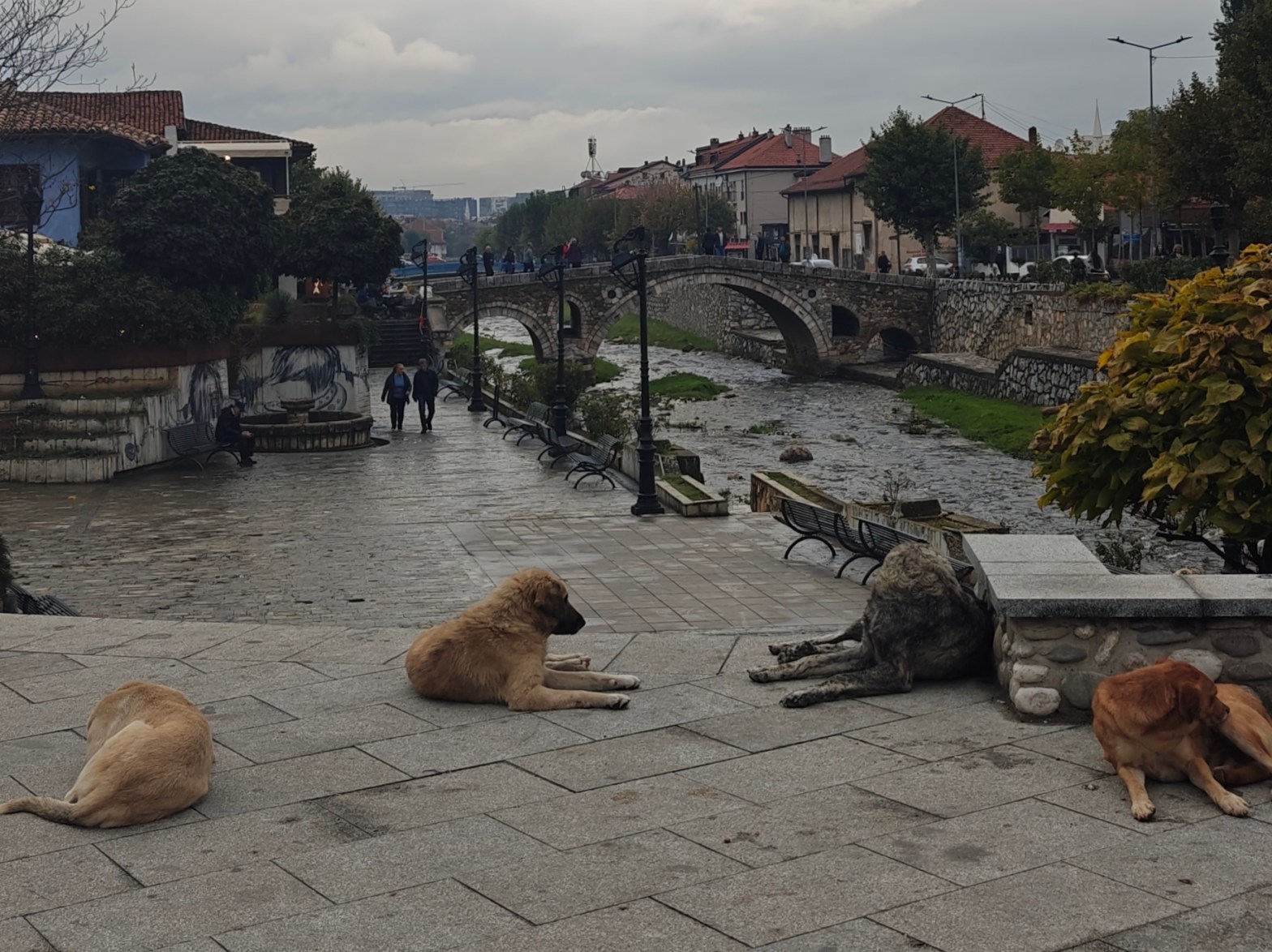
The other thing was the municipal animals. It seems that people here don’t believe in animal shelters. So they keep the dogs and cats on the streets, feed them, vaccinate them and tag them with some plastic tags through their ears.
I think I managed to see most of these two towns in a day, and according to the tourist guides, this is all there is to see in Kosovo nowadays. I’m probably wrong.
I’ve been to Portugal before. Once in Lisbon (in 2013) and twice in Porto (last in 2017), but I had never been on Madeira island before. So we made a round-trip out of it and stayed in all of these places.
DAY 1 – Tuesday, February 11
It was 5 AM and we were sitting on the backseat of a black Mercedes on our way to the airport. In 40 minutes we had got through the 20-minute car ride, luggage drop and security checks and were sitting already at the gate. The flight took us first to Munich and then to Lisbon. We landed around 1:30 PM and after picking up the luggage we took a Bolt to the city center. It cost only 10 euros and 22 minutes so definitely worth it. After some relaxing time in the hotel, we had 2,5 hours to kill before the booked tour in the evening. Our hotel was just around the corner from Rossio Square in the heart of Baixa. From Rossio Square we headed down towards the river along the stone-paved streets. Our first stop was the Elevador de Santa Justa, an elevator from 1902 that takes people up to the viewing platform above the rooftops. As usual, there was a long line of people who didn’t mind waiting for up to an hour and paid 6 euros for the short elevator ride. But in reality, it’s nothing special and definitely not worth the time and money. Instead, you just pass the line and take the streets around a block to walk up to the viewing platform in five minutes for free. The uppermost terrace level was actually closed but the view was still great. Next, we walked to the world’s oldest bookstore from 1732 as I was travelling with a real-life bookstagrammer and visiting this place was at the top of our list. After some Instagram stories later we continued on towards Pink Street, where we met our first annoying grass merchants. I had already forgotten them from my previous visit to Lisbon some 10 years before, but they were just as annoying then. From there we walked along the riverside down to the Praça do Comércio and through the gate back onto the streets of Baixa-Chiado neighbourhood.
Our evening tour started at 6:30 PM from Rossio Square. It was called the Lisbon Food Tour hosted by Samuel, a Mexican living in Lisbon. For the next 3,5 hours, we walked through the neighbourhoods of Baixa, Mouraria and Alfama. The food and the guide were great and we’ll recommend it to anyone interested in the local culture and food. The tour ended at 10 PM and after that, we were more than ready to end the day back in the hotel.
Here’s the list of places and tastings that we had:
1 – Fábrica da Nata – pastel de nata – Coffee 2- A Licorista O Bacalhoeiro – pastéis de bacalhau – octopus salad – Alheira assada – Rosé wine Monte Amarelo 3- A Ginjinha – Ginja liqueur 4- Cantinho do Aziz – beef/veg chamussas – Massamba – Vinho Verde Muralhas de Monção 5- A Muralha Tasca Típica – Picas em azeite picante – chouriço assado – Prego no pão – Queijo da Serra com doce de tomate + marmelada – Red Wine Rendeiro – Moscatel Bacalhôa
DAY 2 – Wednesday, February 12
After a delicious breakfast in the hotel, we packed our bags and checked out at 11 AM. We left the bags in the hotel and went to explore Lisbon some more. The first stop was in the church of Santa Justa, which doesn’t look like anything from the outside but is quite interesting looking on the inside. There was a catholic mass going on at the time, but it was still open for tourists as well. Our only tour that day was with a tuk-tuk (@itukyou). In two hours it took us to see many iconic landmarks in the Alfama neighbourhood. We stopped at several viewpoints and visited some more churches including the Cathedral de Se. Even though it’s the only church with an entrance ticket, there is a way around it, because all the churches are required to have a free part for visitors. The tuk-tuk was a good way to travel because the hills are very steep and walking would be hard. Another option to get to the top of Alfama would be the iconic tram no 28. After the tour, we had enough time to have lunch in a place full of locals and afterwards went to get the best pastel de nata with coffee once again. At 4 PM it was time to get our luggage from the hotel and get us a Bolt to go to the airport. As the rush hour was approaching, the ride to the airport took ca 40 minutes. It was good to get there early because the airport was also packed and it took a while to get through the security checks and reach our gate. The flight to Madeira took ca two hours. From the airport, we took another Bolt to Funchal where we were staying for the next five nights.
DAY 3 – Thursday, February 13
Our first morning on Madeira. At 8 AM we got our first café americanos from the nearby Maia Coffee Shop and brought it back to the apartment to have breakfast. Breakfast in Portugal is usually served really light with just some coffee and pastry. We are used to much heavier meals. But we were planning to take care of that and go to the supermarket to buy some food. As the supermarket wasn’t open yet, we went for a walk to the seaside. We were staying only a few minutes away from the marina. We walked along the promenade towards the “old town”. Early in the morning is a good time to walk through the streets before they get crowded with restaurants and tourists. The doors have beautiful paintings on them, which you see only early in the morning. Suddenly we saw a gondola passing above the street, and then the next one. We had arrived to the lower funicular station, which takes people up on the hills, where the Botanical Garden and the Monte Palace Gardens are located. As the sun was shining and we had a few hours to kill, we decided spontaneously to take the funicular up there. A round trip cost 20 EUR and it was the longest such ride I had ever been on. It took us ca 30 minutes altogether…get the tickets, wait in line and take the ride up there. We chose to visit the Monte Palace gardens as these were just at the funicular station. The ticket costs another 15 euros per person but is definitely worth it. The gardens are located on the mountainside, so be prepared to hike down the hilly paths. But don’t forget that you need to be ready to climb back up again later. We started with what seemed like a Japanese-themed part of the garden and made our way towards the lake in the centre. Next to the lake was the palace itself with some great views down towards the seaside. There were a lot of people but the gardens were so vast that it didn’t feel too crowded. Even the local flamingos didn’t mind. Unfortunately, we didn’t have enough time to spend the whole day up there, so after some walking through the park we decided to climb back up there and take the funicular back down to the sea level. Our plan in the morning was to go to the store after all. So we found it and bought some stuff for breakfast and for some other meals and went back to the hotel for some much-needed shower and rest.
At 2:30 PM we had a whale-watching cruise planned with VIP Dolphins catamaran. We arrived half an hour earlier to check-in. It was a small group tour with only 10 people on the boat and they had two boats out at the same time. The catamaran was really fancy with a lot of room indoors and outdoors, with snacks and an open bar. After an hour of enjoying the beautiful weather, we arrived at the site where the whales were spotted. And there they were…a large pack of short-finned pilot whales native to the island of Madeira. These are really social animals who are doing everything together…diving down to hundreds of meters and then back up on the surface for some air. But they can be down there for a long time so we were lucky to actually see them on the surface for many times in a row. After that, we took the catamaran closer to the coast again and anchored for a while, so that people could go swimming in the ocean. The water was quite warm for the month of February at around 21 degrees Celsius. It doesn’t sometimes get this warm even in the summertime where I come from. After three hours on the sea, we were back in the marina and filled with clean sea air and sunshine. The sun sets at 6:51 PM so walked a bit before returning to the hotel.
DAY 4 – Friday, February 14
The meeting place for a Green Devil tour called “Porto Moniz & Fanal, volcanic pools, memorable adventure“ was in front of the Plaza Madeira at 8:20 AM. We were picked up in an old Nissan jeep, which might have given us an idea of what was coming. Anyways, the pick-up was on time, but it all went downhill from there. You must have heard from folklore or your religious group how the devil operates. It promises you the world, but then there is the fine print, which makes you lose your soul or worse. First, we had to travel about an hour to pick up two more people from the west side of the island. Five people in this kind of small jeep was enough, so that was OK. Our first stop as a group was at Ponta do Sol. It was a 20-minute stop to spend some money in the local restaurant for the right to use the bathroom and to see the view from the seaside pier. According to VisitMadeira “The Ponta do Sol Pier stands out architecturally for its wide perfect round arch, which connects the coastal cliff to the pier. It should be noted that the entire structure was built using regional stone, such as basalt, ashlars and pebbles. At the entrance to the pier, you can find an old prison, carved in the rock, and the guard house. For a long time, the Ponta do Sol Pier was the safest and widest one in the whole southwestern slope of the island of Madeira.“ We had to rely on Internet from now on because the only thing that Diogo (our driver, because I can’t really call him a guide in its regular sense) said was to be back in the car by 10 AM. From there we started our trip over and through the hills to get to the Northern side of the island. From seaside, we drove up to 1600 metres using just some off-road forest trails. This was the part Diego seemed to like…he really finally woke up from his sleepy demeanour and was driving like a devil through the landscape. After what felt like an hour I wasn’t feeling myself anymore. In the end, I only felt sorry for the car, which got so much beating from nature that I was surprised to see it still kept going. For the people in the back of the jeep there was a possibility to stand up during all this beating, but for us in the middle row it was too uncomfortable to stand and there wasn’t anything much to hold on to anyway. Up on the hill, it got really cold and it was good for the driver to close the roof again. It was also there where he said that we had a problem. The problem was that another car from the same company had refused to take the beating from nature anymore and had broken down on another trail. Or something like that. So we had to go and rescue the passengers of that car. After another long drive through the non-existing roads, we finally reached them and then had to wait for another car to arrive. Luckily for us, they had decided to wait at the location where one of the hiking trails passed by. So we got to see what these levadas or hiking trails with water aqueducts running beside them look like. Of course, Diogo didn’t come with us but told us to be back before the cars left. Which was a good suggestion in my opinion as we were in the middle of nowhere. We saw there also a group with another company and surprise-surprise the driver was also operating as a guide. Walking with the group, explaining where they were and pointing out what to see. Like a normal tour guide, you know. But not our Diogo, who was lounging in the jeep and doing nothing. Finally, we were allowed to leave there and the people from the broken car were divided between two cars. We got three nice Dutch people, which made the total number of people in our car 9 including Diogo. That meant it was full without room to move anymore. And the off-road beating continued. In the end, we were about 2,5 hours in the off-road section altogether which felt more like 4 hours, to be honest. During on of the off-road stops we were also given an option – eat your own lunch or go to a restaurant in Porto Moniz, which the Devil had chosen for you. As everybody was hungry already the food sounded good and we had to decide what to eat (like fish, chicken or meat) on the go without knowing the prices or anything. After reaching Porto Moniz, Diogo expertly pointed out one end of the seaside promenade and then the other end, stopped at the restaurant and told us to be back by 3 PM. That was it. We were on our own again. The food on my plate included some fries and a piece of fried fish (allegedly tuna). Asking around the table, everything tasted like chicken there…except the chicken, which didn’t taste like anything. So if you want some good food in Porto Moniz then take your chances with the countless number of other restaurants besides Polo Norte. But if you just want to fill your stomach with something digestible and make it through the wobbling jelly desert then go for it. The coffee was good by the way. But it wasn’t worth the 20 euro price per person. But I understand that the Green Devil also gets its commission when they bring in groups full of hungry people who were lucky to get out of the forest alive. After all this pointless waiting in the restaurant, we were finally able to pay and get out of there to see the town. We had just enough time to walk along the seaside and back. The sea was a bit rough so part of the “swimming pools” were closed, but on the other end, some people were still swimming between the rocks. Visually it looked good, but unfortunately, we didn’t have enough time for it. And our driver had said that there is a much better swimming place coming up in the next stop called Seixal. On the way there we also stopped at the place called Miradouro Ilheus da Ribeira da Janela. Why, I don’t know. And Diogo didn’t say. According to VisitMadeira „Near the viewpoint, at Foz da Ribeira da Janela, the maritime landscape is marked by the presence of large rock formations that rise up in the ocean. At the top of one of these islets, the rock presents an opening that resembles a window (janela) – a peculiarity that gives the name to the stream and the parish.“ So here you go. When arriving to the black sand beach in Seixal, we were given 30 minutes to go for swim „here or there“ before the jeep leaves. When I was asking where the swimming pool in a cave was located, which picture the Devil is using to lure people onto this tour on the Airbnb website, was in another place. As this was the title photo of the tour, then it was also one of the main motivators for choosing this tour from the others. Yes, there are other companies to choose from if you were wondering. Diogo informed me that this cave place was closed and you had to pay there for the entrance. That usually means that these people are not paying tribute to the Devil for bringing people in there yet. That was partly confirmed when Diogo stopped there on the top of the hill anyway and we could see people down there walking, but we didn’t have time to go down there and see for ourselves. By that time the clock was already 4:15. Did I mention already that the tour was supposed to be over by 4:30. That wasn’t happening. We only started our drive back to the south side. This time luckily using the highways and tunnels. First, we dropped the two people off to the southwest corner of the island and then made our way towards Funchal. It had started to rain and there was a yellow storm warning for the evening and night. By 6:20 we were down to 4 people and inside Funchal already. The traffic was very bad and Diogo informed us that it would be another hour to reach the pickup location. So we decided to get out wherever we were and just find our way back to our accommodation through the rain. Diogo, whom I think would make a great taxi driver one day, wasn’t objecting or offering any other solution and we were happy to part ways. This wasn’t too surprising because he didn’t really care about what we were seeing or doing during the tour anyways and he didn’t ask once during the day how we were doing back there or if arriving two hours later back to Funchal would mess up with anybody’s plans for Valentine’s Day, like make them miss their dinner reservations. This was my feedback on Airbnb for the tour organizer as well.
DAY 5 – Saturday, February 15
The rain had stopped by morning and the sun was out again. After breakfast, we went for a walk and for some shopping before the stored closed for the day. There were still a number of discounts going on and we managed to find some interesting stuff. Unfortunately, one of the snack places I had put on my map was closed, so we came back to the apartment instead and had a quick lunch there before the afternoon tour started. The pickup was from outside the Cathedral at 1:30 PM. The tour was run by True Spirit and was called “Cliff Skywalk, Vineyards Tour and Wines Tasting Experience“. It started with three other pickups so in the end there were 8 people in the Land Rover Defender jeep. Our first stop of the tour was the Cabo Girão Skywalk at an altitude of 580 metres, this viewpoint with a suspended glass platform takes advantage of the unparalleled panoramic view of the highest cape in Europe. There was an additional entry fee of 3 euros per person but it felt like worth it. What didn’t feel like worth it was an additional 50 cents entrance fee to the toilet. How can’t they include it in the other fee I can’t comprehend.
After that, the off-road section started. It seems that this is a must on every tour in Madeira. This time it wasn’t as bad as the day before. This part was even fun although it had rained heavily the night before and it was really wet out there. But our guide, Andre, seemed to respect his car much more and was really interested in our well-being as well. As this was only a half-day trip and the main attraction was yet to come, then the off-road part was relatively short.
We arrived at the vineyard just before 4 o’clock. Quinta do Barbusano Winery has been operating since 2006 and has many different properties around Madeira. Among other things, they are also doing tours and wine tastings. This is what we were there for. We started with a short walk through the vineyard followed by stories about the 6 wines they produce. Three whites, one rose and two red wines. They also make sparkling wine, but this was not on the tasting menu. The wine was accompanied by some crackers, cheeses and meats. All good and delicious. After an hour of drinking…sorry, wine tasting…the sun started to set behind the hills. It was time to return to Funchal. We were the last ones to be dropped off just after 6 PM. All in all, a nice day in Madeira.
DAY 6 – Sunday, February 16
No tours, no obligations. A completely free day. What to do?
We started with a walk through the Parque de Santa Catarina. It’s a small park just in the city centre by the cruise port. Full of different plants and a small pond with swans and a small statue of Cristóvão Colombo or as you might know him – Christopher Columbus. The more exciting parts of the park were these small lizards that were running around everywhere and the fact that there was a free toilet around the corner.
We walked back along the seaside and ended up at one of the restaurants I had planned to visit. Theo’s by Chef Julio Pereira is one of the restaurants of the restaurants that he opened in March 2024. We had a table for two on the balcony overlooking the sea. There are also some delicious-looking main courses on the menu but opted to try out some of the classic starters served in two portions. We ended up ordering 4 different ones and that was actually enough for lunch. The price was the same as getting just two main courses in any restaurant and trying out different-looking dishes was definitely more fun.
After lunch, we got some coffee from a food truck by the sea and sat down to read a little in the park there. I chose espresso macchiato, to find out what all the fuss was about. After some more walking and getting some pastel de natas we were done with Funchal. One more night here, then check out and catching our flight to Porto.
DAY 7 – Monday, February 17
After checking out from the apartment, we had a few hours to kill before we had to go to the airport. We spent these hours in the nearby Plaza Madeira mall, as the weather forecast promised rain. It was enough time to read a little and have lunch in a local restaurant. The Bolt took us about 20 euros to get to the airport compared with a regular taxi, which asked 25 euros.
The flight from Madeira to Porto was uneventful. We took Bolt from the airport and 11 euros later we were at the address of our accommodation for the next two nights. Except the accommodation was not in that address. We had been chatting already on WhatsApp with the accommodation representative. I checked several times if I was in the place that Booking.com directions and Google Maps lead us. Finally, we managed to find each other with the accommodation representative via video call. It turned out that the real location was about 5 minutes away on another street. Finally in the apartment, we had time to relax a little before heading out to dinner. It was a recommendation from different forums if you would like to experience Fado music with dinner in Porto (Taberna Real do Fado http://www.realfado.pt). It was just a few doors down from our place so well positioned as well. The doors opened at 8 PM and it was entrance with prior bookings only. We got a table for two just next to the “stage”, which consisted of two chairs for the musicians. We had a choice of the main course to make between traditional codfish dish, steak, vegetarian and so on. There were also different appetizers included (olives, crunchy of alheira, codfish fritters and padron peppers) and a dessert for the last course. The musicians performed three sets. First, just after all the appetizers had been served. The second performance took place after the main course and the last after the dessert. The whole thing lasted three hours. One guy was playing a Portuguese guitar (an instrument with 12 strings mostly associated with fado music) and another one was playing a traditional one. One of the men responsible for bringing us our food turned out to be a great fado singer as well, sharing the stage with a lady called Rute Rita. You can also hear her sing in the following video.
DAY 8 – Tuesday, February 18
At 8:30 we got our breakfast delivered at our door including cereal, milk, orange juice, apples and freshly baked bread with ham and cheese. After breakfast we went to meet with our guide Carlota up on Cathedral Hill. We explored Porto centre and its hidden streets and narrow alleys, from Sé neighbourhood to Ribeira, and the popular “Baixa” (Downtown), D. Luís Bridge, Bolsa Palace, Clérigos Tower, Livraria Lello, etc. It was a private tour and took around three hours including a stop at a popular bakery for some coffee and natas.
For lunch, we bought some pastries and crossed the bridge on the highest platform to the other side. Once in Gaia we ate our lunch on the platform usually reserved for watching sunsets. During the cloudy day the only ones who were watching, were the huge seagulls hoping to steal your food. After finding our way down the hill to the riverside, we headed towards the Sandeman Winery Cellars for a guided tour and wine tasting. It took ca 50 minutes to hear the stories of the history of the place, see the cellars where the wine is stored, see a short movie and then taste three different wines – one white, one ruby and one tawny. Afterwards we took a Bolt back to our apartment.
At 6 o’clock started our food tour. There were four locations. The first one was introducing different cheeses and meats with wines from different regions of Portugal. The second stop was at an alcohol shop serving also vinho verdes with sardines and other fish. The third stop was in a small bar offering different craft beers with warm Portuguese sandwiches and other snacks. The fourth stop was in the allegedly best place in Porto for pastel de nata. The bonus stop was at a tavern next to the university selling the liquid form of pastel de nata, which really tasted like the real thing. The guide, Granado, was a good one, but the food was maybe not as interesting as I had hoped, but there was more alcohol than I was expecting. In the end, I wasn’t hungry or drunk, so the balance was probably quite good.
By the time we finished the tour, it was starting to rain.
DAY 9 – Wednesday, February 19
Travelling all day long. Checked out at 10 AM and reached home after midnight. There was a 4-hour layover at Frankfurt airport, where I had a chance to write this all down.
Here are all the videos in one 34 minutes long version:
Well, here is one country with a too long name for a vlog. I was in Dubrovnik, Croatia. I chose this because of the easy access to Bosnia and Herzegovina from there. It’s basically just on the other side of the hill and the border crossing is less than a hour away.
DAY 1 – THURSDAY
“Ah, my old enemy, stairs!” I felt like Kung-Fu Panda when I climbed the hillside in Dubrovnik to get to the car rental company. I got my VW Taigo and by 8:30 I was on the road to Bosnia and Herzegovina (BIH). There are several routes one can take from Dubrovnik. I chose the scenic route along the coastline due north through the border crossing station called Neum II. There was no line and the border guard just registered my passport and didn’t even check the paperwork for the car. The first impression from BIH was nice. The road seemed new and the tunnels were well built. Until Waze showed me off the main route to the left. It was such a bad road that I even stopped to check the map. But other cars also drove that road so I kept on going. In 10 or so kilometres I ended up on another more road-looking road and followed it to Počitelj. This was just a small village on the roadside where all the big bus tours stopped. After 1,5 hours of driving it was a good place to stretch my legs. There were some souvenir shops and restaurants for the tourists but I didn’t feel like I needed anything. The weather forecast had me believe that it would be really rainy all morning but I had yet to see a drop. But the sky was grey and ominous, which made the light poor for filming. So I decided to skip the Kravice Waterfalls for now and keep on driving to Mostar. As I didn’t know exactly where I wanted to go except the Old Town then that is where I headed. I missed the first turnoff because it didn’t really look like a road and all the following suggestions by Waze were similar or worse. So I ended up driving around the Old Town and finally parked in a City Parking lot near the river. It cost 5 EUR for 5 hours. BIH has its own currency but euros are widely accepted. So I never saw the local money. I took a walking bridge across the river and found myself on a pedestrian street heading towards the Old Town. There were many people around and even more tourists when I finally reached the older part of the town. The most photographed site is probably the Stari Most or Old Bridge. According to Wikipedia, it’s a rebuilt 16th-century Ottoman bridge in the city of Mostar, the historic and currently unofficial capital of Herzegovina. It crosses the river Neretva and connects the two parts of the city, which is named after the bridge keepers (mostari) who guarded the Stari Most during the Ottoman era. During the Croat–Bosniak War, the Army of the Republic of Bosnia and Herzegovina used the bridge as a military supply line, and the bridge was shelled by the Croatian Defence Council (HVO) and collapsed on 9 November 1993. Subsequently, the bridge was reconstructed, and it re-opened on 23 July 2004.
I had just made it through the Old Town when it finally started to rain. As it was lunchtime then I stepped into a nearby pizza place and had a huge pepperoni pizza just for myself. While sitting there I realized that I had the car booked until 8 AM on Saturday morning. If I returned in the evening before then I would need to park the car somewhere in Dubrovnik and there are not too many parking options around. The closest to the car rental agency would charge at least 40 EUR for overnight parking. I decided to book an apartment here in Mostar instead and drive to Dubrovnik early in the morning. It turned out to be a cheaper option and allowed me to return to Mostar on Friday. So the plan was made and the pizza was eaten. The rain had stopped again so I made it back to the car without getting wet. As everything was still grey, I decided to head towards Sarajevo and get there as early as possible to see the city. On the way, I noticed some places I wanted to stop on the way back when the weather was nicer. Like Jablanica and Konjic. Now it was raining properly already on the way. But the rain had stopped again when I reached Sarajevo. The first parking lot I headed to didn’t exist anymore. So I luckily found a spot in the next one and left the car there for my stay in town. The hotel Sana was only like 6 minutes walk from there and I made it by 3:30 PM. The room was nice but small and I didn’t plan to stay there more than needed anyways. The location was good though. Everything recommended to see in Sarajevo was just around the corner. After a short rest, I went for a stroll. Walked through the main pedestrian streets and back alleys up and down several times, looking for food and sights. Due to its long history of religious and cultural diversity, Sarajevo is sometimes called the “Jerusalem of the Balkans”. It is one of a few major European cities to have a mosque, Catholic church, Eastern Orthodox church, and synagogue within the same neighbourhood. There are about 555 thousand people living in the Sarajevo metro area. About half the BIH population are Muslim.
In the end, it started to rain again, so I bought some snacks and drinks from a store and headed back to the hotel, where I fell asleep soon. It was raining all night.
DAY 2 – FRIDAY
The breakfast was from 8AM. My backpack was ready and as soon as I had my latte with three espressos I was leaving the hotel. It started to rain again, so my plan to walk up to the Yellow Fortress was changed. I like these empty streets in the morning when everything is still closed. So I ended up wandering the same streets again as last night. I started with Baščaršija or Sarajevo’s Old Bazaar with an Ottoman-style wooden fountain in the middle. According to local legend, visitors who drink water from the fountain will return to Sarajevo someday. I didn’t. This time the rain stopped and it was light. I saw the Latin Bridge with the sign marking the site of the assassination of Archduke Franz Ferdinand and his wife Sophie by a local Young Bosnia activist Gavrilo Princip in 1914, a murder that sparked World War I. This resulted in the end of Austro-Hungarian rule in Bosnia and the creation of the multicultural Kingdom of Yugoslavia in the Balkan region. Later, after World War II, the area was designated the capital of the communist Socialist Republic of Bosnia and Herzegovina within the Socialist Federal Republic of Yugoslavia. I also saw many Sarajevo “roses”, which is a type of memorial in Sarajevo made from concrete scar caused by a mortar shell’s explosion that was later filled with red resin. Mortar rounds landing on concrete during the siege of Sarajevo created a unique fragmentation pattern that looks almost floral in arrangement, and therefore has been named “rose”. There are around 200 “roses” in the entire city, and they are marked on locations where at least three people were killed during the siege of Sarajevo. By the time I left Sarajevo for Mostar, the sun had come out and gave hope for a better day. According to Waze, it was about three hours drive to the waterfalls and I was planning to make some additional stops along the way. If I look back now then the first warning came when the police were sending the big trucks away in a roundabout in Konjic. But the passenger cars were allowed through. After 20 minutes of driving another police unit stopped everybody and told that the road to Mostar was out in Jablonica and there was no way through for the next few days. But there is an alternative route somewhere and I should consult my Google Maps. So I did because Waze was still determined to send me through Jablonica. But Google already knew and sent me back to Konjic. There I filled up my gas tank just in case and followed the map into the middle of nowhere. About 15 km from Konjic at the site where I was supposed to turn right, I was stopped again. This time by some local men who were speaking only in fluent Croatian. Luckily there were some younger guys there who explained to me what had happened (one even claimed there was an earthquake…not) and that the locals here are cooperating with the police to channel the traffic through the mountain road. I think I was quite lucky to get there as early as I did because there were only like 10 vehicles waiting at the crossroad in a village called Borci. After a while, they claimed that the road was free and that everybody should head up. So we did. The mountain pass was a narrow gravel road with hardly two cars able to pass by one another. As we crept higher and higher the dropoff on the left side of the road went steeper as well. Still, many cars were trying to get to the other way as well. The speed was 10-15 km per hour and I was hoping that no stones would puncture my tyres. It was about 18 km uphill at a crawling pace until we reached the other end of the pass where police were waiting and controlling the chaos. From there it was only downhill on a rather good road compared to the one before towards Potoci and from there to Mostar. It took me more than 2 hours to get through it. There I finally took a moment and had a strong lunch in a local restaurant. I reached the Kravica waterfalls finally at 4:30…about 3 hours later than I originally planned. The sun was shining and there were only a few people on the trail. So it took me almost no time to reach the bottom of the 400 meters of stairs and see the magnificent waterfall. Definitely worth coming here.
DAY 3 – SATURDAY
I was up at 4 AM and out of the apartment by 5 to start my mad dash over the mountains to the sea. That left me about 3 hours to reach the car rental agency in Dubrovnik by 8 AM when they were supposed to open. Despite the early hours on Saturday morning there were still many cars on the roads. I decided to trust Waze again and followed it thinking that I would end up at the same Neum II border station. I didn’t. Instead, the route took me up and down the hills in the countryside with an occasional car here and there. At one point I was a bit worried already that I even drive towards any border station because there weren’t any signs anywhere. But it was too late to turn back so I kept on going. By the time it got light the signs towards Dubrovnik started to show up and by sunrise I crossed the border in Čepikuće. I had less than an hour to go but it was enough and by 7:51 I was at the gate. After the paperwork was done I headed down the hill again and towards my apartment in Dubrovnik. There I finally read what had happened in Bosnia a day before: https://en.wikipedia.org/wiki/2024_Bosnia_and_Herzegovina_floods
Click here to read about my time in Dubrovnik, Croatia.
I’ve been in Croatia before. But up in the north in Zagreb and Zadar and never in Dubrovnik. I chose this because of the easy access to Bosnia and Herzegovina from there.
DAY 1 – TUESDAY
My 9:25 flight to Dubrovnik landed 30 minutes before schedule. I don’t know what their hurry was, I didn’t hurry anywhere. The Dubrovnik airport is really small and it took no time to get through it, buy the shuttle bus ticket from the machine (and ignore the long line) and sit on the bus. It took 30 minutes by bus to get to the Old Town. Only one narrow road connects the airport with the city (and Montenegro, if you go the other way). No need to rent a car to get there, because there is no place to park it. I saw a parking garage prices next to the Hilton Imperial…100 EUR for 24 hours. Unfortunately, the bus didn’t take me close to my Airbnb apartment, so I had to take a Bolt for the rest of the way. The driver recommended a good burger joint (just outside the Hilton) and that’s where my lunch came from. The meat was so good that I used the same place again on the next day.
Check-in was at noon. After a quick rest, I headed towards the town along the scenic road through the Park Gradac. I only lived about a 6-minute walk away from the Old Town. The best way to get the lay of the land is just to wander around aimlessly and see where the roads take you. The Old Town is not that large so it didn’t take me long to go around it from one end to the other. After some hours of aimless walking, I got back to the apartment, picked up my swimwear and headed towards the beach that was supposed to be just around the corner. Actually, it took an endless amount of stairs to get down there. The “beach” was just a rock outcropping with a swimming area marked in the distance with some buoys. You had to slide into the water along the slippery rocks as the waves tried to lose your balance. But the water was nice and warm (and salty) and many people were swimming in the sea. Afterwards, I had to climb the stairs again to get back to the apartment.
My first official tour started at 8 PM and was the “Dubrovnik by night walking tour” (https://www.airbnb.com/experiences/911524). There were only 8 of us in the group and fewer people on the streets as well. It was a nice walk from Pile Beach to the Old Town. The guide was doing a really good job of telling her personal stories and what her family had to go through at the beginning of the 90s when the war raged in the area. Actually, in Dubrovnik, the war officially started on the October 1st, 1991. So it was the 33rd anniversary on that day. The people back then were really surprised to see that a UNESCO heritage site was bombed that way and that the UN didn’t do anything in the beginning claiming it to be just a civil war. Later they ended up paying for the restoration works and now you see only some sharpnel marks left on purpose on the buildings. But for most of its history, Dubrovnik (meaning the oak tree), has been an independent republic well-versed in diplomatic relations and trade. No other wars were fought there because they always managed to use diplomacy first. Napoleon was the first one who managed to derail them a bit. During the II World War Croatia sided with Germany and later became one of the Yugoslavian (meaning southern Slavic) countries ruled by communist Tito. Since 2013 Croatia has been a member of the EU. A fun fact…the name Croatia (Hravatska in local language) comes from the word meaning the cravat, which was first used by the army here. When the French arrived with Napoleon, they really liked this accessory and made it famous all around the world.
DAY 2 – WEDNESDAY
After 9 am I headed to the Old Town again. This time with a plan to do the walk around the city walls. I had purchased the Dubrovnik Pass for 35 euros online and this allowed me to go climbing the walls. Actually stairs. About one thousand of them. The Dubrovnik Old Town wall is the most famous activity all people here are doing. It is about 2 kilometres long and goes around the whole town. By the time I got there, the big groups had already arrived. Mostly cruise passengers of all sorts and sizes. It’s agreed that there won’t be more than 3 cruise ships in the port at the same time. Luckily it’s October already, which means it’s the last month of the season. The season in Dubrovnik lasts 7 months. From November to March, everything is deadly quiet and the people working in the tourism sector are hibernating.
There are much fewer people in October here but still it gets crowded sometimes. The walkway along the walls is quite narrow and when somebody is stopping to take photos then everyone else behind them has to stop as well. Luckily there are wider areas as well and it wasn’t too bad to walk there. The weather was nice and sunny and up to 20 degrees. All in all a perfect day for such a trip. According to the guide the night before it could be done in 45 minutes or 2 hours if you take it really slowly. I almost made it in 1 hour but then just before the end, they had a nice bar there with drinks to go. So I decided not to waste a beautiful view and sat there on the wall for a while and had a drink and did some serious people-watching.
After the wall, I decided to try the cable car that would have taken me up the hill to the fort that the French built at the beginning of the 1800s, but the line there was just too damn long. It was a good thing that I hadn’t bought the ticket yet. Instead, I went to Fort Lovrijenac, which is a small castle just outside the Old Town built to protect one another. The entrance was covered by the same Pass. The fort is nowadays used as an event venue and you can rent it if you have 7000 euros to spend. Plus all the other costs from food, decorations etc. Something was happening on the same evening and the preparations were on the way. Maybe a wedding. Maybe a wedding of the same Asian-looking people I saw on the wall and in the old town taking photos in their wedding attire. Weddings are a big business for the region and many companies are working in the destination wedding niche.
After lunch and shower (because of all the stairs) I was scheduled to have another private tour called “Eight beautiful locations just outside of Dubrovnik” (https://www.airbnb.com/experiences/1325074). It was hosted by Roberto whose English was not the best but whose tour is a must if you want to see what the countryside around Dubrovnik is all about. We started with Park Orsula, an archaeological site with a panoramic view and the most beautiful summer event stage. The next stop was a most interesting abandoned tourist complex of the Former Military Resort in Kupari. This was the most fancy resort for military personnel during the Tito time. The next stop was in the middle of a small village, which you couldn’t find on your own. The Mitrej small open cave is a historical religious sight from the time of the Roman Empire. In Ljuta we stopped at a popular restaurant with Old stone mills, waterfalls and beautiful promenades through the dense shade of the forest. Before returning to Dubrovnik we had a homemade sandwich with a sage drink in the shade of a large oak tree next to the Pridvorje-Franciscan monastery. On the way, we stopped also at a traditional agricultural cottage which is a good example of traditional construction in drywall technique and visited the Gray Falcon viewpoint. We were back in Dubrovnik for another beautiful sunset at the seaside.
DAY 3-4 – THURSDAY and FRIDAY
Click here to read all about the adventures in Bosnia and Herzegovina.
DAY 5 – SATURDAY
After returning from Bosnia and Herzegovina in the morning I had a day off. Until at 6 PM I had booked a food tour „Marvelous tastes of Dubrovnik“ hosted by Marina (https://www.airbnb.com/experiences/4033434). There was another couple from the US as well, so just a small group. We met outside the Pile gate and went in for a tour of history and food. Our first stop was at a local seafood/street food restaurant called Barba, where we had a selection of seafood, with a glass of local wine. I would need to go back for their black octopus burger. We made a second stop at another local restaurant called Pupo Tavern where we were offered black risotto with some more seafood, followed by another glass of wine. Our next stop was at Enoteca wine shop where we tasted a local red and white wine. The final stop of our food tour was at a local coffee and patisseries bar Gianni. The strawberry homemade cake was to die for.
By 9 PM we were full of good food and enjoyable conversations and the tour was over. Just 5 minutes later a huge thunderstorm hit Dubrovnik. I spent the following hour on the central square in a bar drinking non-alcoholic beer Pan and watching lightning and wet people running around. All in all a fun evening.
DAY 6 – SUNDAY
It was raining in the morning. The different weather forecasts couldn’t decide when it’s gonna stop. I made my way through the Old Town when it was still dribbling little and made it to the 11 o’clock ferry to Lokrum Island. I bought the ticket online on the same day and therefore didn’t need to stay in line in the Old Port. They go every half hour and it’s only 10 minutes ride to the island. The island is a nature reserve and no people can stay there overnight. The weather had cleared, the sun was up and I made my way to the top of the island. There are some fort ruins there. Altogether something like 17 different spots are marked on the map and the trail goes through them all. It wasn’t too many people on the island so I only met some others occasionally. From the fort, I continued to the seaside location called Skalica Cove, where the claim that even Richard the Lionheart moored his ship while looking for refuge from the raging sea on the way back from the Crusades. Next to it is a Lazaretto, originally meant as a quarantine site against the Black Death as Dubrovnik was the first town to introduce this 40-day-long quarantine for all the people to fight the plague. The one on the island was never finished because locals figured out that this kind of fortification near the town would be an ideal location for the enemy to set up shop.
Archduke Maximilian Ferdinand of Habsburg had a mansion built on the island in 1859 with a magnificent garden laid out, criss-crossed with pathways, full of amazing plants and botanical wonders. The island was originally purchased by Maximilian’s wife Charlotte of Mexico, with part of her marriage dowry, and she retained ownership of the island even after she and her husband became Emperor and Empress of Mexico. After the Emperor Maximilian’s execution, the island was surrendered to the Habsburg Family. In 1959 a Botanical Garden was founded on Lokrum which contains native and imported, tropical and subtropical plants, and other vegetation originating in Australia and South America. The island is also inhabited by families of peacocks brought over by Maximilian from the Canary Islands.
The Benedictine Monastery is perhaps the most predominant of all Points of Interest on Lokrum. The Monastery was first historically referenced in 1023 and existed until some point in the 15th century at which point the Benedictine Monks were forced to leave the island. Popular legend states that, upon their eviction from the Island, the monks of Lokrum passed a curse on any who possessed the island. A portion of the Monastery has been converted into a restaurant and another segment has been converted into a museum. In the museum, I stumbled on the replica of The Iron Throne from the HBO series The Game of Thrones. I had successfully managed to avoid everything connected to the series, but no more. The throne was quite comfortable to sit in. I took the 4 PM ferry back to town and spent a nice day in nature.
In the evening, I returned to the Old Town and went through some of the places recommended by the guide the night before. I went back to Barba seafood place to have the octopus burger and then through the hole in the wall (Mala buža) to have a drink on the outside of the city walls in a bar on the cliffs.
DAY 7 – MONDAY
It was a beautiful sunny day, which was perfect for the speedboat cruise I had booked. It was hosted by Damir (https://www.airbnb.com/experiences/4768984) and during the 5 hours he took us to the most gorgeous islands in the Dubrovnik area – the Elafiti Islands. They are decorated with evergreen Mediterranean vegetation surrounded by a crystal clear sea, blue and green caves, sandy beaches, medieval ports, and villages. Twice we had a chance to go swimming into the caves and use the snorkeling equipment to see the fish and different colours in the sea. After swimming we drove another 20 minutes to the other side of Lopud island. There we found a nice small marina with a kilometer-long promenade along the seaside dotted with restaurants and souvenir shops owned by locals. The stop was a little over an hour which was enough to see the cathedral and walk along the promenade from one end to the other. We were back in Dubrovnik by 3 PM.
After watching the last sunset I headed back to town to have dinner in one of the restaurants recommended by the captain today. The Bistro Tavulin turned out to be the perfect last meal of the trip. Today was the first day of the Dubrovnik Good Food Festival. In the restaurant, they had a special 3-course menu prepared for the occasion, which cost only 30 EUR. For any other day, you could only get one course in the place. And it was delicious.
Dubrovnik left me with good memories and emotions and I would recommend it for a visit. Just not during the summer. The shoulder months of April/May and October are better.
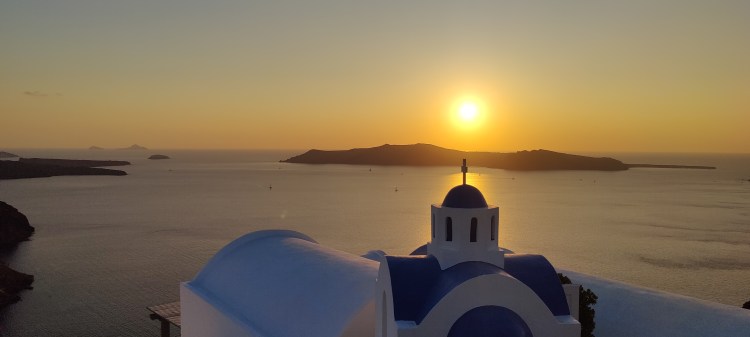
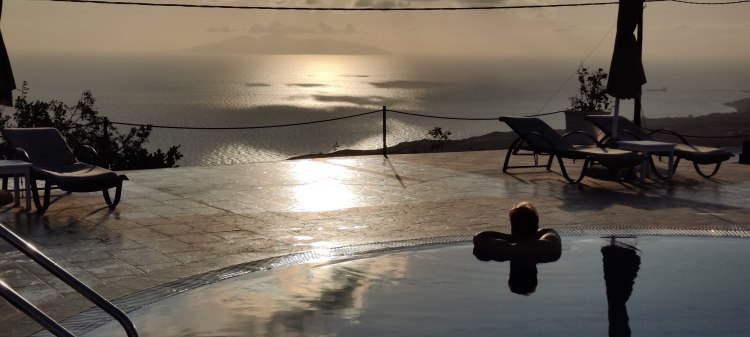
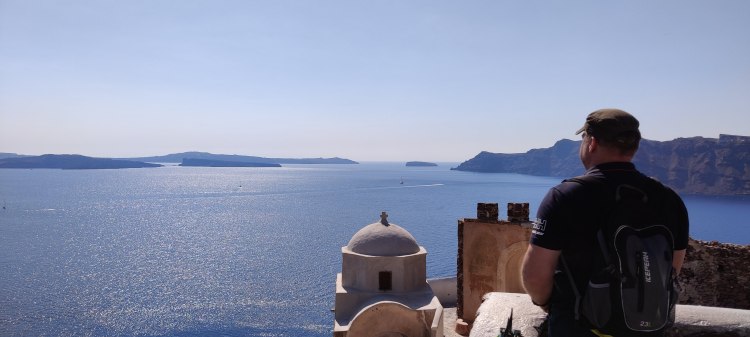
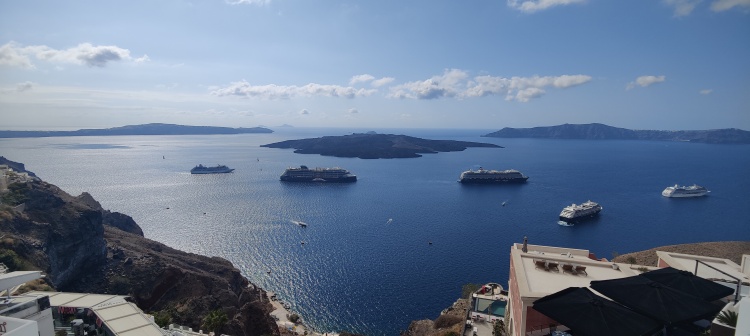
An island in the Aegean Sea with many names. Belonging to Greece, it sits on top of a volcano along the largest caldera on Earth. It’s a popular Mediterranean tourism destination for both luxury tourists and the ones with a more reasonable budget. To me, it’s also all about sunrises and sunsets. Here is just one way to spend a week there.
DAY 1 – WEDNESDAY
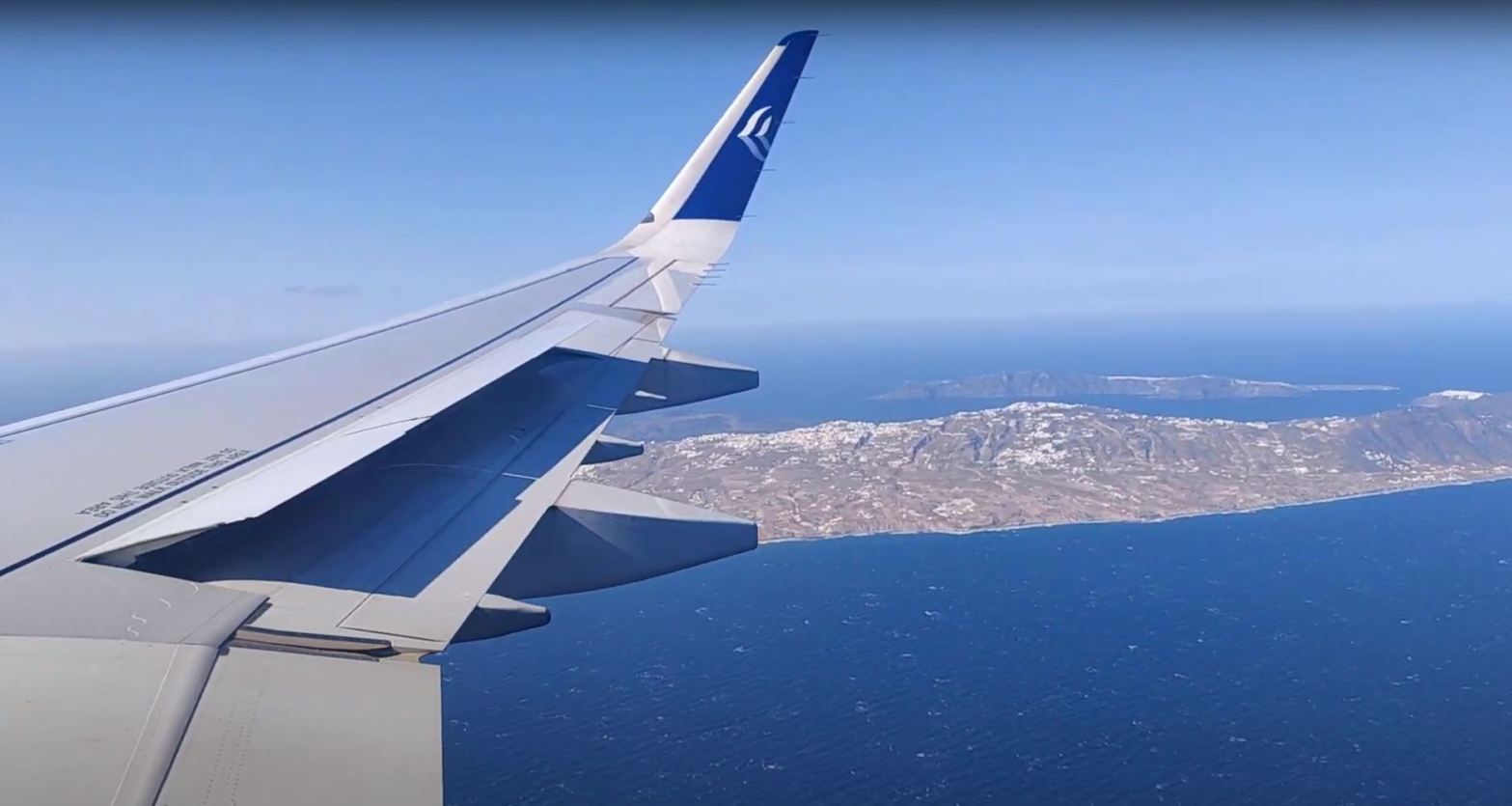
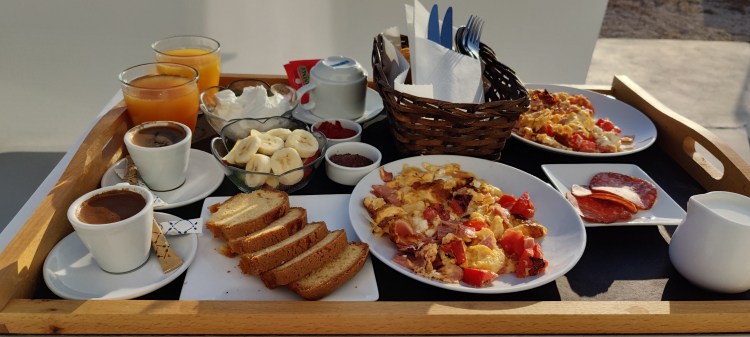
Arrival day. Our first flight departed towards Athens already at 3:30 AM. That meant no sleep during the night. I still managed to get a few minutes of sleep during the flight just before Aegean Airlines surprised us with some snacks and drinks. In no time we were in Athens. There was a 3-hour layover before our short flight to Santorini. Officially only 40 minutes and we were there. If Athens was cloudy then Santorini had clear skies and fierce winds as usual. The temperature in the middle of October was still around 22 degrees Celsius but the northern winds made it a bit chilly. The airport is small, and the luggage arrived on the belt just as we were taken there by bus. We had rented a car from AutoUnion, whose representative was already waiting for us outside the terminal with a sign and took us to their office a few minutes’ drive away from the airport. I had chosen this car rental agency, because they were mentioned in a blog I had read, and their website described clearly what the total cost would be in case of full insurance. Usually, the rental agencies only tell you the basic rate and then try to sell you more insurance once you get there. So, this was a pleasant change. Additionally, they had a really low backup fee of only 200 EUR per car. In some other cases this could be up to a few thousand euros which the rental agencies book from your credit card. We got a small Suzuki Swift with automatic transmission and Android Auto connectivity, which allowed us to use Waze for navigating without any additional phone holders. Always rent a small car on Santorini, because as you will soon see, there is no place to put a bigger one. So, in one hour from when the plane arrived, we were able to reach our hotel. It was located in the village of Imerovigli called the Golden East. It was a nice small hotel with only seven rooms, a pool and a 24/7 sea view. Unfortunately, our room was not yet ready as we arrived there just before 12 o’clock. But the guy at the reception desk checked us in, explained to us how everything worked, and made us order our breakfast for the next morning. As breakfast is served in your room you have to set the time and menu beforehand.
All that made us really hungry, so we decided to drive to the village centre and find some lunch. Just after finally finding a parking spot I got the call that the room was ready. But we decided to eat first as planned. The number one place in TripAdvisor was still closed so we wandered through the narrow streets and ended up seeing some nice views over the caldera. Our wandering finally took us to another fast-food restaurant called Jimmy’s with low prices and a really Greek menu. We ended up ordering big portions of kebab and pork skewers with some salads and fries and really enjoyed the experience. There was also a cute yellow cat with blue eyes begging us to feed it and so some of the kebab pieces found their way under the table. There was a small market next door, where we got us some local wine, bottled water (as the tap water on the island is not drinkable) and some volcanic soaps as presents. As there are no street signs anywhere the best way to find your car again is to mark the spot on Google map. Later I found out that we had parked the car in one of the best sunset spots on the island. Back in the hotel, we found our room ready and everything was as lovely as expected. We did not have long to enjoy it because being up all night finally kicked in and we decided to nap before doing anything else.
In the evening, after making some plans for the next day, we felt hungry again. Luckily, there was a highly recommended tavern called Steki Tou Nikou just a kilometre away. The only way to get there is by car because the roads up there are dark and narrow, which makes walking there not advisable. The place was cozy with some other couples enjoying their food already. We sat down and ordered some moussaka, Greek salad and grilled Greek cheese. The food arrived shortly and was delicious as expected. In the end, we were surprised with some small ice-creams as desserts, which was a really nice gesture.
Now, after writing all of this down I only hope that in the morning we see why this place is called the Golden East, as we hope to see the golden sunrise from the east right from our terrace and see what breakfast is all about here.
DAY 2 – THURSDAY
Breakfast was everything and better. But before breakfast, there was the sunrise at 7:22 AM. We had the best view from our terrace. Then came the food and the sunrise went even better.
By 10:30 we finally managed to leave the hotel. The plan for the day was to explore the more remote areas on the island. For that, we drove all the way to the southern tip of Santorini to visit the Akrotiri lighthouse. The drive took us around 40 minutes. There was a car park about 100 metres from the lighthouse but as the Waze instructed us to get even closer, then we drove right up to there. Luckily, one car was just leaving there, otherwise, we wouldn’t have been able to find a spot. It was just a short walk around the lighthouse on the cliffs facing the caldera. Around the corner, however, more of a view opened up. The sea was full of catamarans and other crafts. The cliffs were amazing and the view was spectacular. By some miracle, we even had the place for ourselves for 10 minutes or so before other people started to arrive.
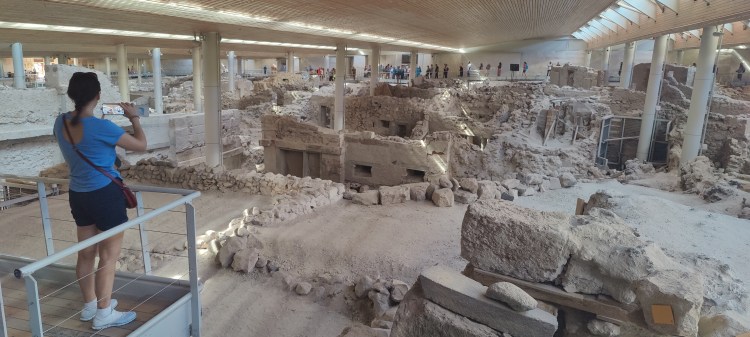
The next destination was the Akrotiri archaeological site. The excavations started already in 1967 and they have unearthed part of a city built in the late Bronze Age (1650-1500 BC). People had lived in the area already in the middle of the 5th millennium BC, but many earthquakes had demolished the site during different ages. Before the end of the 17th century BC, the rebuilding was finally cut short by the sudden eruption of the volcano, which buried the city under the mantle of pumice and volcanic ash, which preserved it for posterity.
From there it was only a few minutes’ drive to Red Beach, which got its name from the reddish cliffs towering above the seaside. There is also a White Beach and a Black Beach on the island. The trail went over the cliffs and then down to the beach. We didn’t go all the way but reached the viewpoint over the bay. It was not that we didn’t want to go for a swim but the trail itself was not really inviting. But if you are not worried about some loose rocks falling down on you when you try to navigate the narrow trail down the cliffside then definitely go for it.
As we couldn’t get the swimming idea out of our heads, we decided to drive down to Perissa Beach. It is a small resort town on the southern coast. It was a very pleasant down as there were almost no cars or people there. The street along the beach was full of expensive restaurant wannabes and the black sand was full of colourful umbrellas. Yes, this is one of the black beaches. The other famous one is the Kamari, but this one here is allegedly more instragrammable because of the cliffs. We managed to find a changing booth outside one of the restaurants and made our way to the waves of the Mediterranean. The water was warm by our standards, but there weren’t too many people in the water. They were mostly lounging on their beach chairs under umbrellas. I have never understood this “activity” as something I would enjoy doing. As it was almost 2 PM already then, we were a bit hungry. Luckily, there was a bakery on the side of the parking lot. It turned out to be a really good choice. Actually, the choice was pretty overwhelming, so we ended up buying lunch with coffee and also some delicious snacks for later.
On the way back was a small town with a pretty name – Emporio. I had read that it was not like any other on the island. First, it was more yellow than white colour-wise. Secondly, it had these narrow winding streets going up and down the hill. You could never see more than some cats, a few meters in front of you and sometimes the streets were too narrow for two persons to walk past one another. But still, somehow, we managed to find our way around the town and back to where we had parked the car. Google Maps was totally disoriented there. But I liked this place, it was like a treasure hunt where you never know what you will find around the next corner.
Before driving back to the hotel, we stopped at one of the slightly bigger supermarkets by the road. It had a really good selection of foodstuff. We even ended up buying some grilled chicken, salad, tomatoes and tzatziki sauce for the dinner.
We were back in the hotel after 5 PM. I had just enough time to go exploring what I could see from the hilltop behind our hotel. There was a steep road going up there. To steep maybe for the car, but maybe not as there was a battered Smart Car up there. I was surprised to see a really nice footpath going along the topside. It went through a hotel and down to the other side. And on the other side was the most spectacular view over the caldera I had yet to see. Then I noticed some cars down there and found out that I could also drive there easily. Just keep towards the Santorini Princess Spa hotel and you’ll find it. So, I went back to the hotel picked up the car and drove there for the sunset, which was at 6:47 PM.
After the sunset, we had our grilled chicken dinner at the hotel and relaxed after the first full day on Santorini.
DAY 3 – FRIDAY (the 13th)
Our day started with a swim in the hotel’s outdoor pool just after sunrise. It was a refreshing and beautiful, quiet morning. After another healthy breakfast, we hit the road again. Back towards the south. We visited first the Lost Atlantis experience. It had one of the theories of where Atlantis once stood (spoiler alert: it was here in Santorini) described in many audio-visual screens and information boards including a 9D cinema performance. It felt a little too touristic but gave a good overview of why Plato might have written about Santorini and not about any other places featured in these theories.
Just a 6-minute drive (it would have been 3-minute drive, but I managed to go in the wrong way in the beginning) from the Lost Atlantis is a place called the Heart of Santorini. We found the parking lot, but the trail down there looked dangerous. So, we enjoyed the view from up on the cliff over the caldera and the cruise ships in there.
We spent the afternoon in Fira, the capital of Santorini. The first recommended parking lot on the south side of the town was full. Even waiting there for some spots to open didn’t give any results. So, we drove a few hundred metres further and found a practically empty lot where cars were parked. We walked around the town and stepped into some shops here and there. The streets took us all the way up to the edge of caldera, where all the fancy restaurants and cocktail bars are located. We even managed to purchase some gifts and other stuff during our walk. Before leaving the centre square, we had a light lunch of stuffed pita (souvlaki) with drinks and Greek-style cold coffee (Freddo Cappuccino).
Back in the hotel at 5PM. The sun was still high enough to fill the hotel pool with golden light. So, we went in and soaked for a while in cool water and sunlight. Around sunset, I went up to the hill again and tried to capture another timelapse of the sunset with a small chapel in the corner.
DAY 4 – SATURDAY
Day started (after the swim and breakfast of course) with booking a boat tour to the volcanic islands in the vicinity for Sunday morning.
But today we went to Oia. This is considered the most touristic village of them all. It’s located on the northern tip of the island. It’s considered the destination for sunsets. So, we went there in the morning. Well not exactly in the morning. It was 11 AM. Oia was already full of tour buses and cruise passengers, who came with them. There is only one way in and one way out of there and the first parking lot was already full. There was a second one dedicated to the sunsets, but we managed to get a spot there behind a dumpster. It turned out that the real paved and nicely made parking lot was 50 meters further on and totally empty. Even closed by the look of it. Everybody parked on this dusty piece of land just before that. The location was good though. Just around the corner was one of the first viewing spots I wanted to see anyway. The trail started going up and down, left and right along the cliffside. Nice small boutiques everywhere and views to die for. We managed to get some locally handcrafted jewellery from one small shop with a sleeping cat on the window. From the other store some linen shirts. Many stores had a 20% discount going on. The same happened in Fira the day before. Nice to be here in October. The next viewing tower was in a tower of Oia Castle. Or what’s left of it. There was however a musician there playing Greek music in the background.
After that, the streets got a bit wider. By the time we reached the Blue Domed Church, we were tired and hungry. We even got weak enough to step into one of the patisseries on the seaside. But after seeing that an espresso with a view cost 6.50 we backed out of there quickly. Instead, we went a few streets inland and found some more reasonably priced dining options near the bus station. After lunch, we headed back to the car using different streets than before. Getting out of Oia turned out to be easy. We just had to follow a big bus. On the way, we decided to take a look at an unofficial beach with an interesting name – Pori. It’s only funny if you know our native language of Estonian. The beach itself wasn’t funny at all. Just a small stretch of land with black sand and stones. Not inviting at all. There is another beach called Kanakari, which sounds funny as well, but we decided not to go there. Back in the car, we now only had to climb the hill to get back to our accommodation on the top of it. The change of altitude made my ears pop. We finally got our coffee in the local Carre Four store for just 2 EUR per drink. We did find a nice bottle of locally made Vin Santo (like ice-wine) there and bought it for the evening. With some slices of pizza, which saved us from finding a place for dinner. Back in the hotel we had a long refreshing swim in the pool and had another nice time-lapse video with the sun setting through the moving clouds. There haven’t been as cold and strong winds during the past few days. I hope it stays that way also tomorrow when we need to take the boat trip around the caldera. Looking forward to it.
DAY 5 – SUNDAY
Santorini is one of the most spectacular islands in the Aegean Sea. It sits on top of a volcano. What remains today is a crescent-shaped island enclosing a vast bay, the largest caldera on Earth, consisting of the islets Thirasia, Nea Kameni, Palaia Kameni, Aspronisi and Christiana complex. The official name of the island is Thira (Thera), but it’s also called the black pearl of the Aegean. Worldwide it’s however known by the name given in honour of the island’s patron saint, St.Irene of Thessaloniki, who died here, while in exile in 304 AD. Approximately 15,000 residents live here, but during tourist season this number increases drastically. According to Greek mythology, the first name for the island was Strongyli (I.e., round) because of its shape. The first colonists called it Kallisti (meaning beautiful), until the volcanic eruption in 1615 BC (or 1613 or between 1550-1500 BC depending on the source), which destroyed the island and the Minoan culture on Crete at the same time. During the 8th century BC, a Theban hero called Thiras, left his reign in Sparta and with a group of noblemen settled on the island. The island subsequently took his name, Thira, and has been known as such ever since. Christianity reached the island in the 3rd century AD. The foreign seamen started to call it Santa Irini, which with the passage of time became Santorini. The island suffered many earthquakes and volcanic eruptions during the centuries. The last big earthquake in 1956 caused great destruction on the island and took the islanders many years to recover. The volcanic eruption also caused the islet of Neo Kamini to appear. You cannot claim to know Santorini if you haven’t seen the Caldera from the sea. That is why we are heading towards the so-called Burnt Islets today.
I was looking for a tour of the islands, which would start from the Athinios Ferry Port. There are many boat tours around. Mostly (semi-)private catamaran tours, like the one the hotel suggested to as ( ca 190 EUR/pp). Most of them start from the Old Port in Fira, but in order to get there you would need to find a parking space and then walk down 586 steps or take a cable car. We had a car and therefore it was much easier to drive all the way down to the newer port. It’s a scenic winding road which goes about 3 km on the side of the hill. We found a good parking spot there and went looking for our boat Kalypso. It arrived well ahead of time and first, we foolishly thought that we were going to have a private tour. But no. I had chosen a group tour with a boat for only 38 EUR per person. Five minutes before the scheduled departure arrived Anastasia with a huge group of other tourists whom we had somehow missed. Everybody was ushered onboard, and the tour started on time. People all gathered on the sundeck upstairs in the aft. That became too crowded for me, so I went searching for a better spot downstairs. I found it in the bow of the ship. Quiet and with a great view (without any tourists on the way). That became our place for the rest of the trip. We stopped briefly also in the Old Port of Fira and picked up some more people, but the first planned stop was on the island of Nea Kameni. The entrance fee to the National Geological Park was 5 EUR per person. The path up the hill took us about half an hour with some stops on the way. You could see craters from different eruptions there. Each having a name like Mikri, Daphne, and Georgios. Here is a good video of how Santorini was created by the volcanos – https://www.cuervito.gr/santorini-volcano-history/ The Georgios crater lie near the volcano’s summit. It is the result of a hydrothermal eruption that took place in 1866. The adjacent smaller crater was formed in 1940 and just on the side of it is the lava field, which was created during the last big eruption in 1956. Inside the main crater you can observe the release of hot gases and smell sulphur in the air. The rim of the crater is located over 120 meters above sea level.
The way back took us another 30 minutes or so and we were happy to get back into the shade of the ship. The stop on the island was altogether 75 minutes. The next stop was just around the island in the cove of the smaller Palea Kameni islet. There were some hot springs where people were allowed to swim to. As the ships are not allowed to moor there for more than 30 minutes at a time, it had to be a quick swim. The water temperature in the hot springs was allegedly around 25 degrees. But it was really nice after the sweaty hike around the volcano. The third and final destination was Thirasia Island. It’s the second biggest island in the group and around 300 people live there officially. Mostly fishermen. We had 2 hours there for lunch and rest. We picked a local taverna in the harbour and ordered ourselves some fried calamari, squid and local fish with chips and salad. All very delicious and not overly expensive. At 3:20 the ship departed for the final trip. As our ship had a glass bottom it was also possible to observe a reef under the water. Who knows what is beneath it…maybe even the lost city of Atlantis. The ship sailed along the cliffs of Thera all the way from Oia to Fira and finally back to the Athinos harbour, where we arrived at 4:30 PM. It was cool to see Santorini from the seaside and be in the middle of all the maritime traffic in the caldera.
After some quick stops on the way, we arrived at our favourite sunset spot just in time to see it one more time from the cliffs above. Back in the hotel, it was again time for a swim in our “private” pool. We seem to be the only guests here who use it. Go figure.
DAY 6 – MONDAY
We gave the car a day off. But we didn’t give the car away. That would have been a huge mistake because considering where we live, in order to get somewhere you need to have a car. There are buses between towns, but these never go where you want them to go. They all go to Fira and then you need to transfer to another bus. You can’t really walk anywhere, because there are no roads for pedestrians. You walk on the side of the road if you have to. That being said, having a rental car in Santorini is the only way to go. A car, not an ATV or scooter or a buggy.
Today I went for a walk. A totally planned walk. As we live just over the hill from the famous Fira-Oia hiking trail then I took advantage of it. People usually start from Fira (because most of the people live there), and walk through Firostefani, Imerovigli to Oia. According to the official accounts, this should take approximately 3 hours one way. Once in Oia, you need to figure out how to get back. You can take the bus to Fira or take a taxi anywhere. As I had already been to Oia, then walking there didn’t have any appeal to me. So, I went the other way towards Fira instead. As we live somewhere between Imerovigli and Oia then that made sense. First, the trail went uphill to Imerovigli. Once there, I kept my eye on the Skaros rock or a castle as it once was. The trail that goes there off from the main one is hard to find. Mainly because there are no signs anywhere. You could find the trailhead because of the panting tourists, who had just returned from the side-quest. First, there were stairs, many stairs down. Then there was a sign saying that “access to Skaros Castle after this point is extremely dangerous and is strictly forbidden”. I didn’t see anyone who cared. Only the three dogs, who were resting in the shade of a large rock.
The well-worn trail went around the cliff and down on the other side to a small church on the side of the hill. Whoever thought this would be a good place to build a church. The Skaros Castle was built on this naturally fortified location in the 13th century by the Barrocci family, (1207-1265) and was the first Venetian capital of Thera. The serious volcanic eruptions of the 18th (1707-1711) and 19th century (1866-1870) forced its inhabitants to abandon Skaros and settle in the modern capital of the island, Phera (Fira). After climbing back to the top of the Imerovigli village and some serious panting, I continued on along the trail. It was cool to see several photoshoots happening. It is a big business here to have yourself photographed in a long flowing dress. There were three of them going on at the same time. The best job to have there is the person, who has to throw the hem of the dress up high at the exact moment the photographer is ready. The next village was Firostefani. Along the seaside, it’s pretty difficult to tell when one village is ending, and another is beginning. I decided not to go all the way to Fira, because I knew I had to climb back up again from there. So, I turned around and went back. The circle took me 3.5 hours and was as good a hike as I hoped it would be. After some rest and a swim, we returned to Firostefani. This time by car to find something to eat in a local tavern. We finished just at sunset and could see the last glow of the sun on the horizon. That was our last night in Santorini. The wind had picked up again.
DAY 7 – TUESDAY
What a wonderful morning. Last sunrise, last breakfast, two hours of packing. Check-out was at 11 AM. We had a whole day ahead of us before our flight in the evening. Sometimes less is more. We drove to the Kamari beach on the east coast of the island. It’s a resort town with a long black sandy beach. The promenade along the seaside is full of small boutiques and restaurants. Some already have closed for the winter but most of them were still open. We did some shopping and had lunch and coffee in a local seaside lounge. After lunch, we found a bunch of sunbeds belonging to one of the closed restaurants and spent a few hours there on the beach reading and aeroplane watching. As we were already quite close to the airport, all the planes approached it over the beach. We had driven 219 km during these days and made it everywhere we wanted to go. By 6 PM we had changed for colder weather again, refuelled and returned the rental car and were waiting in the airport for our gate to open. After a short stopover in Athens, we finally landed in Tallinn at 2:45 AM.
Here are all the videos together one more time with locations:
As I was already in the neighbourhood, it was time to stop by. So, it was time to leave Morocco behind and move on to Tunisia. There was a direct flight from Casablanca to Tunis.
Wednesday
The flight was at 1.55 PM but better be safe than sorry. So, I started early and made it to the 9:50 airport train from Casa Port. I first had planned to take a taxi, but there seemed to be something strange going on with the taxis in the morning. The white ones were not allowed to take me to Casa Port and the red ones seemed to have a habit of also picking up other people for the same ride. As far as I understood there was this babbling grandmother with her grandchild that wanted also to the same small taxi with me. I said no thank you and opted to walk instead. It was close enough and the street was OK for the luggage wheels. After a 45 minutes train ride, I was already at the airport. The check-in gates were already open, so I dropped my bag there and went through the formalities as usual. Everything went smoothly and once I was on the other side I discovered that there was still a bottle of water in my backpack. Good work, everybody. As I had time then I spend an hour reading and then went to have lunch. This was probably the most expensive airport meal I ever had but at the same time, there was no currency exchange anywhere to change my Morocco dirhams into something usable. I also checked the similar items as I had purchased the day before from the souk and found them three times as expensive in the airport. So compared to that the lunch wasn’t expensive at all.
The flight to Tunis took 3 hours by Royal Air Marocco airline. The biggest surprise there was that they actually served food for everybody on that flight. I can’t even remember when I got a warm meal on one of my other 3-hour flights. It has been years. And it was actually delicious. I felt like royalty.
Tunis airport was quite small but again everything went very smoothly. This time they were also interested in my cameras but it was just a quick peek into my backpack. This airport already had an ATM machine next to the luggage carousel and gave me a nice stack of 20 TND notes. 1 Tunisian dinar is about 0,30 EUR or 1 EUR is about 3+ TND at the moment. Finally, my suitcase arrived as well and together we went outside the customs area to get back online with a local Orange SIM card. As soon it was done, I opened my Bolt app and found myself a taxi. The annoying part with Bolt in Tunis is that they only take cash, so you can’t pay with your card in the app as usual. The other thing I noticed here is that all the taxi drivers seem to call me through the app like I couldn’t find them otherwise or whatever they wanted to say. The reason to use the app in a foreign country and without speaking any local languages is the possibility not to talk but just enter the destination and not discuss the fee afterwards. So I just kept on ignoring all the calls. Taxis here are yellow and small and in bad condition. What else is new.
It was raining. Filippo, my host in the Airbnb arrived quickly and let me in the apartment. A quite nice one in fact with some interesting furniture (designed and made by the owners) and with a small balcony. The first order of business was to find some food for breakfast. There was a Carrefour nearby so I took my umbrella and went to search for it. There seem to be some milk crises in Tunisia because there wasn’t any milk or yoghurt in the store. Later I found out that all the milk products are actually exported out from Tunisia and the locals don’t seem to get a lot of it at all.
THURSDAY
The next morning the rain had stopped. I spent the first part of the day walking around the city centre of Tunis following a self-guided tour on my phone. I used the GPSmyCity app for that. This has a 3-day trial version which was all I needed for Tunisia. It took me along the large avenues into the older part of the town and narrow winding alleys in the souks down there. Somehow it was less annoying there compared to Morocco. The merchants were not as pushy and everything looked a bit nicer. But still, everything looked tired and broken and trash was everywhere…even with trash bins in sight. There were some demonstrations going on. I don’t know if was it because of that or if it’s normal, but everywhere were police officers and soldiers and some monuments had barricades around them.
Had lunch in one of the brasseries close to the apartment and went back afterwards. For dinner, I decided to look up one of the suggestions my host had sent me. The name of the restaurant had changed but I went in anyways. It looked good as well as the menu. Which was in fluent French and Arabic only. But for that reason, you have Google lens translator in your phone. I ordered lamb with rice and it was the best lamb and rice that I had ever eaten. Everything worked also very quickly and I was even able to pay with a card.
FRIDAY
It was stormy day with strong winds and hard rain. I didn’t do jack that day. Except stayed in the apartment and binge-watched Jack Reacher and Jack Ryan on Amazon Prime.
In the evening I was finally hungry enough to get to the nearest street corner and bring back a nice pepperoni pizza.
Sounds like a holiday.
SATURDAY
My last chance for sightseeing. The weather was beautiful. Sunny and up to 10 degrees Celsius. When staying in Tunis then the most obvious and closest attraction is the Carthage. To be honest, there is nothing left except some ruins here and there. But the name of the once powerful city still lives on. The ruins are not from the original Carthage but the Roman version of it. The best sights are actually the amphitheatre and some roman baths by the sea. But I’m getting ahead of myself. In the morning I took a taxi to the Carthage Museum location on top of the hill. It was wise even though the museum itself was closed. I bought the ticket from there, which works in seven different locations around the area for 12 TND and started to follow my self-guiding tour route down the hill. I used the GPSmyCity app for this area as well.
As I already said, the amphitheatre was quite a site. From there I walked up the hill again to the location of some roman villas. Actually, there was only one of those walls restored just a little some decades ago and is therefore now somewhat recognizable. But it was a great view from up there on the Mediterranean. The route went down to the necropolis and through the terms toward the sea. On the way was a small site with some artefacts found during the excavations. The Punic Port was the last on the list and is nowadays just a small round cove for some fishing boats and birds.
From there I took another taxi to take me some 3 km up the hill to the village of Sidi Bou Said. It’s a picturesque small village near Carthage, where they have applied the building style across the Mediterranean. All the houses are white with bright blue windows and doors (with some yellow exceptions). It’s popular among the locals as well as tourists. Walking around the narrow streets, sitting in cafes and buying stuff like local pottery is apparently something the locals are there for.
I had lunch in one of the restaurants where they served me a pan with some spaghetti with meatballs and some really nice herbs. After lunch, I went for half an hour’s walk towards the beach of La Marsa. Another popular destination for people in Tunis. It’s a small resort town with lots of restaurants and nightlife. I sat on the beach watching the waves, walked along the beachfront streets and enjoyed the nice day by the sea. Around 3 PM there was a train that took me back to Tunis for 0,8 TDN (dinar is subdivided into 1000 milim or millimes, so the train ticket cost only 800 millimes). To compare, the delicious eclair I bought a little while before cost 3 TDN. The train was cheap and tired-looking and stopped every few hundred metres to pick up more people. But in the end, it took us all to the city centre of Tunis straight over the causeway, where it was just a short walk back to the apartment.
After a shower and little rest, it was time to go hunting again for some food. I had an idea to finally find some couscous that had eluded me in Morocco (where they apparently only make it on Fridays and I didn’t know it on Friday yet). But the dish originates allegedly from Tunisia, so I expected to find it here more easily. I hadn’t however on the first days and now was my last chance. I found several places in the vicinity with couscous in the menu. But they were all out of it for today. Another place I got recommended was suddenly closed tonight. Another place that Tripadvisor recommended didn’t even exist anymore. But who said that hunting should be easy. So finally, I ended up at an Indian fast-food joint where they served me a huge escalope with rice and sauces and naan bread with some fries and a coke to go. It was a good meal but still no couscous. Maybe next time.
SUNDAY
Time to go home. I packed my stuff, ordered a taxi from Bolt app and arrived at the airport early enough. I had some 100 TND still left, so I changed these back to euros before the customs. Because on the other side of the security, it was only possible to pay with euros or cards. No more Tunisian money.
The flight was scheduled for 1:30 PM with boarding starting an hour before. When nothing happened, then I got a little gut feeling that this is going to be interesting again. My homecoming trips usually are. At 1 PM they changed the departure gates and moved the people to the other end of the airport. The staff over there didn’t seem to know anything about the flight to Milan, though. The information boards refused to declare a delay for the flight although all other TunisAir flights were already delayed by that time. At 1:22 the information screens declared that the flight had departed. Funny, guys. At 1:30 finally the screens said that the estimated departure time is 2:00 PM and soon after they actually started to let people on board. So around 2:10 PM the flight finally took off.
In Milan I had to self-transfer to another flight. Originally I had 2 hours between TunisAir flight to Milan and WizzAir direct flight back home. That would have been more than enough time. Thanks to the “funny guys” in Tunis with some “help” from the baggage staff in the Milan Airport I managed to get my suitcase less than 1 hour before my next flight. By that time I already knew that I couldn’t make it because the luggage drop-off/check-in counter was supposed to be closed 1 hour before that flight. I went and checked anyway but no luck. So I went to Skyscanner.com, searched for any flights from Milan towards home and found a Finnair flight scheduled to leave a few hours later. So I bought myself a new ticket, and went directly to the check-in counter to drop off my bag. There were many Finns returning from a ski holiday in the Alps and all of them had skis with them and too heavy bags. So it took a while before I managed to say goodbye to my bag. The customs part went easy and I went directly to find some food before my long flight home through Helsinki.
Again there seemed to be a slight delay with the departure time which was especially nerving because I had only 50 minutes in Helsinki between two flights. When we arrived then it had shrunken to around 35 minutes. The Finnair app said that we will arrive at gate 36A and the next departure gate was going to be 17. So I prepared myself for a long run through the airport. Luckily, before my run, I checked once more the local information screen and found to my surprise that the departure gate had been changed…to 36. So I screeched to a halt and turned around. I was already here. As my seat number on both flights was 8A, then I was wondering if they are going to use the same planes as well. But they didn’t. It was another plane. Still, the staff in the Helsinki airport is so efficient that they managed to get my bag from one plane to another in 30 minutes and it travelled safely with me for my last leg of the day. Arrived after midnight, but was still happy to be back home. Now I just need to hope that my travel insurance will cover the unexpected new plane ticket purchase.
It did. A month later. At least part of it because the airline responsible for the delay didn’t issue any reason for the delay. During the insurance process I found out that TunisAir is one of the least punctual airlines in the world. The same Tunis-Milan flight have once during past five months been on time. It’s like every time it comes as a surprise for them that they need to fly somewhere. One time there was even 546 minutes delay. That is over 9 hours. So good luck with your TunisAir flight. You are going to need it. Or just do not plan anything else for that day.
Arrival day. Started at a reasonable time in the morning, and arrived to the airport so early that I was the first one to cross the Schengen border in the airport. Anyway, I had time to enjoy the sun and start a new book.
The first leg took me to London Luton airport. Wizzair was a really nice experience; three hours later I was already there. The layover was just a little shy of two hours. Enough to get the luggage, drop it off at the Easyjet counter and go through the security check again. The only thing was that my bag was 2 kg too heavy for the Easyjet automated drop-off scale. So I had to take a bag out of it and put it in my backpack instead. First things first – Burger King – because I was starving already. After the meal, the boarding had already started, and I found my way to the next plane to take me to Marrakech in Morocco.
The plane was full and the only thing to note was a group of guys that went to have a birthday party in Morocco. The cabin crew should have known better that after selling them 2 litres of vodka, would come back and bite them in the ass. The guys got drunk and the cabin crew had a hard time keeping them seated when needed etc. But everything ended well (maybe not for these guys) and we arrived in Morocco in time. Going through the passport control went quickly. The first order of business was getting myself a local SIM card from Inwi. The second was to get money from my card to pay for it in cash.
In half an hour I had managed to do all that and went to look for my private driver, who had come to pick me up. Really nice guy and a pleasant service (welcomepickups.com). The only thing was that the hotel I had picked, was in the middle of Medina where the cars can’t enter. Only pedestrians and motorcycles. So I had to walk the last bit to my accommodation. I managed to get lost twice but finally found the right door and arrived safe and sound. Luckily, I already knew that I couldn’t rely on the locals to help me so I had to do it all by myself. The locals didn’t know that however and tried to make me lose my way on two occasions during this 200 metres of walking.
I stayed at Riad Alqimam. The room was quite nice as expected. On the top floor with a terrace and view over the city. But before I had a chance to enjoy it, I had to find some food. So, I went back to the winding alleyways in the Medina and looked for a place to get something quick. I wasn’t interested in spending time in some restaurants and opted to find something from the street vendors. I chose a place where some locals were queuing as well. I have to find out what the name of this food was but basically, it included bread filled with boiled potato, boiled egg, rice, ginger, pepper sauces and some other stuff. It was delicious and cost only 10 MAD or 1 EUR. I took it back to my terrace with the view and enjoyed it under the moonlight. Finished the book too.
DAY 1 – WEDNESDAY – MARRAKECH
Woke up before dawn and alarm clock to the sound of the morning prayer from a nearby mosque. Breakfast was at 8 AM and my tour of the day started at 9:30 from the Jamaa el Fna Square (or the big square as it is also known). It took me only like 10 minutes in the morning to walk there and twice as much in the evening when the streets were full of people and merchants.
It was a guided city walking tour (https://www.airbnb.com/experiences/909455). The guide’s name was Abdelilah (Abdo in short). Born and raised in Marrakech and a licensed tour guide by the Moroccan Ministry of Tourism. I was the only client so I got a private tour. The tour started in the famous Jemaa El Fna Square. This place is considered a UNESCO World Heritage site. After that, we went through Riad Zitoun Lakdim (16-century old neighbourhood) discussing local hammam culture and comparing these with saunas back home. The first site to visit was the Bahia Palace. This is a masterpiece of Moroccan architecture, it was built in the 19 century. The palace is lavishly decorated with Cedar wood ceilings, carved plaster, Moroccan traditional tilling and marble. All are in perfect symmetry and built according to Islam traditions. This place explained to me also very well what is the difference between different house types. In order to call it a riad a house needs a garden with trees/plants and a fountain in the middle of the courtyard. A dar is happy with just a fountain. There is a third type as well but I forgot the name. The entrance cost 70 MAD but it was well worth it. Then we went through some alleyways to visit Madrassa ben Yousef (a former Islamic university). It cost another 50 MAD to enter but the restoration work and architectural details there were incredible. Relating to that, my guide also explained to me that as Marrakech is under UNESCO heritage and is also called a red city, then even the shade of red colour on the houses is important when renovating them. Of course, not all houses follow that rule.
After that, we went to see other parts of the Souks, likewise, the blacksmiths, Souk of leather carpet makers and saw artisans make some beautiful things from wood, copper, leather etc. Carpets and stuff made of leather are something Morocco is famous for. As it was a private tour then I managed to take me also to a quality jewellery maker and bought a beautiful necklace with some earrings made of real stones and designed according to Tuareg traditions. All this needed some serious discussions over the price but we finally settled in the price range I was happy with. I really hope I didn’t get scammed too much. At the end of the tour, I invited the guide to have lunch with me at his favourite street food place. I had also a personal interest in that…to try a local place where tourists don’t go and eat something new and well made. He took me somewhere I would have never dared to go alone even though it was just next door to the Minaret de la Koutoubia in the city centre. The cost for chicken stew with bread and tea for two cost me only 32 MAD.
While eating I got a message from the next tour organizer, I was supposed to meet at 5 PM for a food tour. Apparently, they didn’t have enough people booked. It was just me. So they suggested I change the date to Friday. So I did. And had the rest of the day off.
In the evening I grabbed another potato-egg-burger-thingy from “my guy” around the corner and went to explore the big square again. When it was empty in the morning, during the day it hosts snake charmers and dancing monkeys. In the evening though it changes into an open-air food court. Row after a row of different food vendors. It was good to walk through it with a full stomach. I’m back up on my Riads rooftop terrace writing this chapter here and the lights went out. Just here and nowhere else. After a while, the lights came back but I didn’t mind the darkness one bit. Just me, a sky full of stars and a bunch of horny cats on neighbouring rooftops.
DAY 2 – THURSDAY – MARRAKECH
The first tour of the day was a cycling tour (pikalabikes.com). Luckily the starting point was really close and I had no trouble finding it. Arrived a little early but there were many people already waiting. As I understood, we were divided into groups based on the preferred language. Our English-speaking group of 8 ended up having at least fluent French speakers. So go figure. The bikes used were quite comfortable city bikes with three gears. After learning three hand signals for turning and stopping, we hit the road. Without any helmets or colourful vests. Now it’s probably a good time to explain the traffic laws of Morocco. Basically, there are driving lanes, traffic signs, crosswalks and roundabouts like everywhere in the world. They just are not operational. Meaning that people are driving like animals. There are animals on the road as well. Mostly chickens, cats and donkeys. The donkeys even have their own traffic sign so that they would know where they are not allowed to go with their carts in tow. And pedestrians are on the lowest level of the importance chain. Next are probably donkeys, then all sorts of bicycles, motorcycles etc, then the one Ferrari and then all the Dacias ever made. Dacia is probably the most popular car brand in Marrakech. The roads are narrow and go through the souks (or market areas) and are sometimes even somewhat paved. Going cycling through all of that was magic bordering madness. But somehow all of this works. Another wonder is that you almost don’t hear any car horns like in some countries across the Mediterranean. People are used to all the bicycles passing them while the motorcycles are passing the bicycles until there is a donkey on the way arguing with some cat about a chicken. Anyway, in two hours we drove along every imaginable type of road, made some stops, passed through the royal palace grounds without stopping (because this is not allowed), drove inside the Old Medina and also through the New Medina (where I saw the only Ferrari in Morocco) and arrived back safe and sound. Oh, I also saw where the storks go for a winter holiday. After returning the bikes, we were taken to the nearby cafeteria for refreshing cold drinks and sweets. I had already before decided to have lunch there as well, so I ordered my first Tajin of the Day, which happened to be a vegetarian one. It was delicious and so far the most expensive meal I had had here (60 MAD).
After returning to my Riad I realised that I had been on the wrong tour. It had been the right place, right time and right activity but another tour. Somehow nobody bothered to explain that there were probably two tours starting at the same time. The one I had booked was supposed to take me more outside of the city to see some palm groves and oases and be more off-road. Well, let’s say that everything happens for a reason and somehow, I needed what I got.
My second tour of the day started at 5PM. It was called “Dinner In Agafay Desert With Camel Ride With Sunset” (https://www.airbnb.com/experiences/2937111). It started with a drive into the desert about 45 minutes from the city centre. There were some 15 of us in the group and only three (including yours truly) had booked the camel ride. So, we were taken around about 15 minutes while the rest of the group waited. Then we were taken another few kilometres to the Alkamar Camp on the top of a hill where a restaurant tent was waiting with sweet tea and sunset. The sunset was just after 7PM and was really beautiful on this clear day colouring the desert and the Atlas Mountains in its golden glow. After the sunset, dinner was served. Everyone had to choose from different options (at least 3 or four main dishes) with some appetizers and fruit as dessert. I chose chicken with lemon and this was probably the best chicken I had ever eaten. The lemon and olives and everything just added perfectly to the taste of the well-cooked bird. The appetizers or side dishes included six types of vegetables – like potatoes, red beet, carrot, avocado and some other spicier stuff I didn’t recognize. The tables were set for two, but as I was travelling solo then I got the same amount of food as others had to share among themselves. I wasn’t complaining. The only annoying thing was the local musicians with their drums and monotonous singing. They just didn’t know when to stop. They were so loud and were moving from one table to another without missing a beat. It was just me probably because some other people were clearly enjoying them and even dancing along to the rhythm. I just wanted to escape into the moonlit night. But it was chilling outside. The deserts always are after the sun sets. The difference in temperature was colossal. Luckily there was a small fire outside where all the people were gathering for some warmth until the “mariachi” band finished and we could drive back to town. The Big Square was still busy with all the people, food and music but the streets of the Medina were already emptying with the stores closing, and merchants on the way home leaving piles of rubbish behind on the streets. It was my third day and I haven’t spotted a garbage bin yet anywhere in the public space. I will keep my eye out and report back when I see one.
DAY 3 – FRIDAY – ESSAOUIRA
I found a garbage bin. It was in Essaouira. In a small seaside resort town on the Atlantic coast. It’s 3 hours drive from Marrakech, so we started already at 8 AM (https://www.airbnb.com/experiences/3729703). There were a few stops on the way to stretch your legs and use the toilet. One of them was the same that all the tour companies use. So it was packed with minibuses. The highlight of the stop was however the local public transport in a form of old battered Renaults, Peugeots and other ugly old cars. I can’t imagine these would pass any technical inspection. But these are in active use transporting locals from small villages around the plains into the town centre and back.
The next stop was along the roadside in an Argan Oil Cooperative. It was only around 2004 when the women in Morocco got equal rights with men. The more active women are now allowed to form cooperatives and earn their own living, selling products made there from argan tree nuts. Different oils, lotions, creams etc. Quite expensive as well.
Just a little while after that you could first spot some big trees along the roadside full of goats. Yes, there were goats sitting on trees. Apparently, the goat farmers have “trained” the goats to climb trees and eat the leaves there or just look around. I’m not sure this requires some animal protection agency involvement or not. This morning however there were also police officers under each tree and they didn’t allow the goats to climb. The goat herders apparently didn’t know why the police were there. Maybe they wanted to climb the trees themselves.
We finally reached Essaouira around noon. The old town is quite small… just some parallel streets full of merchants as anywhere else. Selling the same crap nobody needs. Next to the old town was a small fishing port full of blue fishing vessels, fresh fish salesmen and a flock of seagulls. We were given some directions on where to go and what to see and the deadline when to come back to the bus. We were on our own. Our guide didn’t have the right licence to offer guiding service there in the town…that right was only for the local cultural guides. So, our guide was just offering transport service and went to listen to the local imam, who talked about gossiping on that particular day in the local mosque. Apparently gossiping is a big problem for Moroccan men…they seem to leave their homes in the morning, socialize and drink “Moroccan whiskey” (green tea with mint) all day long and gossip. Women do all the housework as men do not do them and watch Turkish soap operas on TV. The only thing men do at home is tea. And they do not make tea in the kitchen but on the table where it’s served. That they do it at least 7 times a day and drink it with a lot of sugar. It’s probably in their genes already as diabetes is almost non-existent in Morocco.
After walking through all the back streets and visiting the fortress along the city wall (where they filmed some parts of the Game of Thrones…it seems that GoT was filmed all over Europe) it was time to find some lunch. I opted to do that on one of the popular squares where I ordered the Menu du Jour, which included Moroccan soup (mainly lentils), fried squid with fries and a dessert. Now the thing to understand about desserts in Morocco is that it is not what you would expect. The dessert includes usually just fruit. In my case some oranges with spiced sauce. At the same time, they sell everywhere a staggering number of sweet cookies, cakes and biscuits. But these don’t qualify as desserts as these sweets are eaten with sweet tea seven times a day. But we’ll come back to the food later again.
After lunch, I stopped in an organic cafeteria to have some of this tea and use the time to charge my phone. I had another hour to kill before the bus was leaving. So, I decided to walk to the seaside. It was a beautiful sandy beach (awarded with a Blue Flag for good measure). There were not too many people there although it was clear skies and 18 degrees Celsius. It’s still winter for the locals and too cold. Some people were still swimming there in the ocean and I decided to try the water as well. The water wasn’t cold at all, similar to the summer temperatures back home. I even managed to find some ice cream while I waited for my feet to dry in the warm sand. The drive back took another 3 hours with one stop in the middle and we reached Marrakesh just after 8PM.
I wasn’t done yet. As a few days ago I had to postpone my food tour (https://www.airbnb.com/experiences/710571) to this evening, I had to meet the guide for that at 8:30 PM. Three other guys were participating and the host also brought another guide along. So, the six of us went to explore the food scene in the Medina. It was a nice concept to give an overview of the different meals of a local in 3 hours. If you have read (or seen the movies) Lord of the Rings or the Hobbit by Tolkien then you know the eating habits of these small creatures. The hobbits were always wondering why people didn’t understand their need for the second breakfast or luncheon for example. The Moroccans understand. Their first breakfast is a light soup with some bread with olive oil. Followed by the second breakfast a few hours later, which include usually pancakes with either cream cheese or jams or peanut butter or something similar. Around noon they have a snack. In our case in the form of blended fruits. Lunch is around 2PM and includes only meat. We had some skewers barbequed on hot coals and included chicken liver and some minced veal meat. Next, we had some chawarma, which is a popular Middle Eastern dish that originated in the Ottoman Empire, consisting of meat cut into thin slices, stacked in a cone-like shape, and roasted on a slowly-turning vertical rotisserie or spit. I believe this is what the locals consider dinner. In the next place, we shared some cakes among ourselves together with some delicious yoghurt with honey. Last but not least we went back to the big square to have some snails as dessert. This was definitely the most unique “dessert” I had ever had and not my first option for the last tasting of the night. This had probably something to do with the strong French influence Morocco had had in the past. Surprisingly all of this managed to stay down in my stomach and felt not so difficult at all. Maybe because we also had at least 3 cups of green tea during the tour to wash it all down. It was almost midnight when I finally took my ass back to my Riad. It had been a long day.
DAY 4 – SATURDAY – ATLAS MOUNTAINS
Time for another tour (https://www.airbnb.com/experiences/388245). This time to the Atlas mountains. The tour started at 8:30 so I managed to have my breakfast before that. Now I knew that I had had the “second breakfast of hobbits” every morning in the hotel including the different pancakes, cream cheese, jams etc. It was the same tour guide as the day before. This time he took us to his home village high up in the mountains. It was just an hour’s drive from Marrakesh with some stops on the way. We even followed the same beautiful mountain road that Tom Cruise used to ride his motorcycle in the Mission Impossible: Roque Nation movie. The first one was again in a local women’s cooperative. This was not as fancy as the one on the previous tour. But this time I was more ready to buy some stuff to help the local business as I knew the story already and I’m always for helping local entrepreneurs. The next stop was on a village market. This is the highlight of the local social scene. Nobody works on Saturday when there is a market happening. This is the place where the locals bring their chickens for sale and buy their weekly vegetables. And the gossip of course. Because all the buying and selling is done by men. No women participate in that.
After the market, we were taken to the village centre where all the Atlas Mountains hiking trips start. Some people take it really seriously and go for many days or even weeks. There is always someone who is also climbing the highest peak in North Africa, which is located nearby. Mount Toubkal is standing an impressive 4167 m tall. We didn’t have that ambition. Our goal was to climb up to the 2000-metre mark and have lunch there. The winding trail along the mountainside took us about 1,5 hours. At the beginning there I was surprised to hear some Estonian language and find a family with at least three small children walking there as well. The guide’s home was in the last village with a breathtaking view of the mountain range. It was a beautiful clear day but so high it was quite cold and still had some snow and ice along the route. There were many people around. Some going up and some down, looking at the cascades and waterfalls or just enjoying the scenery. The home-cooked meal included again Moroccan lentil soup (this time with some additional spices for good flavour), chicken tajin with a vegetarian option and a dessert in a form of some bananas and clementines bought from the village market before. After lunch, we had to walk back down the hill. Being a little slippery because of ice and mud made it a bit difficult, but everyone made it back safe and sound. The bus was waiting for us to take us back to Marrakesh by 5PM. This time I had the evening off. No more tours. Time well used for writing this here and watching the full moon rise over the city.
DAY 5 – SUNDAY – MARRAKECH
My last day in Marrakesh. The plan was to do the garden tour. Meaning visiting the few green oases in the city. The first in line was the Jardin Majorelle ca half an hour’s walk away. On the way there I passed another recommended Instagrammable site called the 7 Saints. It turned out to be a parking lot for taxis. So, if you are allergic to yellow Dacias then don’t go there. The garden turned out to be difficult to find. I managed to walk around it before I found the right entrance. With a lot of people queuing outside. Including some Estonians. This was apparently a really popular spot to visit. So, I bought a ticket online. The first available timeslot was 1,5 hours later. In the meantime, I decided to walk to the train station and see how it will look like the next morning. While I was there, I bought my ticket already beforehand so I wouldn’t have to wait in line with my luggage. The recommendation is to buy the ticket from the counter instead of online where they charge you twice the same amount. I had my first taxi experience on the way back to the Majorelle Gardens. No taxi meter so we agreed on 30 MAD (3 EUR) for the trip. The gardens are connected with the Yves Saint Laurent museum and look especially colourful and well-kept. I thought it would be bigger for the 150 MAD price tag but in the end, I believe it was a fair price for the beautiful photos and peace you can find there from the bustling city outside the garden walls.
I had some other sites marked in Google Maps, which I hadn’t had time to visit yet. Unfortunately, they were on the other side of Medina like 3+ km away. I opted to walk there anyway. While walking I passed through another park which seemed to be sponsored and connected with the Telecom Museum. On the way back to Riad I finally stepped into the Secret Garden, which I have passed every day at least twice. It’s basically two connected luxurious riads with a nice garden (not as nice as the Majorelle) and a correct Islamic layout. I had heard many people praising this garden, but really, I didn’t understand what the fuss was about. After lunch at my favourite potato-egg-rice place, I had a few hours of rest before my last tour in Marrakesh was to start (https://www.airbnb.com/experiences/3075544). It was a 2 hours long evening walking tour through the Medina. There was another Scottish-Irish couple on the tour. I somehow managed to start on the wrong foot with the guide. Something did bother me about him. It turned out that the problem was probably me. The guide managed to remain professional throughout the whole trip and managed to show me some places I hadn’t been to yet and details I didn’t know before. The tour ended with us being on the rooftop terrace with a view over Koutoubia Mosque and having tea. So in the end it was worth it.
DAY 6 – MONDAY – CASABLANCA
Time to check out from Marrakesh and move on to Casablanca. From Red City to White City. From inland to the Atlantic coast. From a city of 1,5 million to the biggest city in Morocco with 5 million inhabitants. But first I had to get a taxi to the train station. After negotiating the price – 70-50-60-40-50 – I reached the train station an hour before my scheduled departure. I had already bought my ticket so there was only to wait. The train’s 1st class was quite full and I was apparently lucky to buy it a day before. The train ride to Casa Voyages took 2 hours and 40 minutes. So, enough time to start and finish a short story in my Kindle. The thing to note is that today’s password in the CodyCross game was Oasis. It was Casa Oasis station that I needed to avoid just before my real stop at Casa Voyages. The long line of red taxis (Dacias of course) waited for me already and one annoying taxi driver tried to lure me into his car. Before you let anyone take your suitcase or get into the taxi you need to negotiate the price. His offer was 120 MAD. My answer was to approach the other drivers and ask them who would take me. A nice older man agreed to take me to the hotel for 50 MAD, which I was happy with. The check-in to Hotel de Paris went quickly and by 1 PM I was already unpacking my suitcase. I had also booked an introductory tour (https://www.airbnb.com/experiences/1420846) in Casablanca by 3 PM. The guide however changed the time twice during the last 24 hours so it finally started at 2 PM from outside of McDonald’s restaurant. I was only happy to combine my lunch there with the tour. A man can eat only so much lentil soup and tajin for one trip. And I could ask the Big Mac in French, which is Le Big Mac (according to Pulp Fiction). It was a private tour just for me. As the Casablanca centre is quite small and the Medina is a fraction of what it was in Marrakesh then the tour didn’t take that long at all. We managed to cover a lot of ground in an hour. Through the Medina, the fort, by Rick’s Café (the fakest famous thing in all of Morocco), along the seaside to the Hassan II Mosque. We arrived there just after 3PM. As this is the only mosque in Morocco that let non-muslims in for a visit on certain timeslots, then I was really lucky to get there at that time. The time slot was from 3-4PM. So, the guide took me quickly to the entrance and left me there to buy the ticket and have a look at that amazing building. Built only recently compared to the Koutoubia Mosque (from 1147 AD), in 1993, it is the biggest active Mosque in Africa and the 7th biggest in the world with a capacity of 25 000 people indoors. Built on the water on the Atlantic coast is a feat of its own. There were a lot of people there already and it seemed that it was good that I arrived a little later. So, I didn’t have to wait in line or anything. The place is huge. It took me some time to locate the English-speaking guide. Even though it was a big group, it took me a while to get there. After putting our shoes back on, the guide took us also to downstairs to the Hammam area, where the ritual cleaning takes place. By 4 PM we were all standing outside in the sun again in awe of the magnificence of the building.
It was only like 2,5 km back to the hotel so I walked through neighbourhoods of all sorts. The contrast was huge as I was close to the city centre where my hotel was. But everything was much larger and airier and whiter than Marrakesh had been. I would even stretch the truth a little and say it was a bit cleaner…
DAY 7 – TUESDAY – RABAT
Didn’t sleep well at all. Was a little worried about how I would get to Rabat in time for the tour there (https://www.airbnb.com/experiences/4557538). The train network information is a bit confusing here and isn’t clear from which station which train to which direction and what time will go. So, I had an early breakfast and walked to the nearest train station – Casa Port. Another beautiful modern building. Seems that infrastructure investments here have included also train lines. The ticket machine didn’t cooperate with me, so I bought a ticket from the counter again. To my surprise, I was in the right station and there was a direct line to Rabat Ville station where I wanted to go anyway. The only thing to note was that the doors of the train closed just before I reached them and the electrical connection with the power line was turned off. Apparently, there was a crew shift on the train. When the new crew embarked and turned the engine on again, the train started to move. It stopped a moment later and opened its doors again but for a second there I was thinking “what a hell”. An hour’s train ride later I was in the administrative capital of Morocco called Rabat. It’s where the king lives (when he is not in his Marrakech palace) and where all the ministries and other administrative buildings are located. I was supposed to arrive by 10:15 and my tour was supposed to start at 11 AM. During the train ride, I got a message from the host that he had some urgent business to attend to and would be there by 11:30. It was fine by me. I had one thing I wanted to take care of here anyway and visit one site by myself. While doing that I actually saw a policeman trying to control the traffic by standing in the middle of the road and signalling with his hands. Brave guy.
By 11:15 I got back to the meeting point and texted my host that I had arrived and will have a snack in the café across the street. By 12 o’clock the host replied that he had now finished with his urgent business and will start to drive to the meeting place promptly. By 12:40 I let him know that this was getting ridiculous already. At 1PM I decided that enough is enough and went to explore the city by myself. I believe that waiting for two hours out of a four-hour-long trip for the host to arrive is more than accommodating. I understand that hosting only one person is not feasible enough but pulling a stunt like that is not nice. First, I walked through some souks in the old town out to the riverside. Then along the river to the nearby museum Kasbah of the Udayas. Walked through that and ended up on the Atlantic coast again next to the beach. On the left side was a huge cemetery and, in the distance, Phare de Rabat or the lighthouse. On my way back towards the city centre I decided to get some local food and opted for some fried sardines inside a large bread with different salads, spices and stuff I better not know. The “burger” was delicious as they always are. I ended up at the Gare de Rabat Ville again just before 3PM. As the train back to Casablanca was due at 3.05 and I felt like I had seen all that there was to see by myself, I bought the ticket and just made it for the train. By the way, the taxis in Rabat were blue.
Back in Casablanca, I went back to the souk in Medina to buy some gifts for my family back home. Ignoring the annoying ones and visiting some nicer stores I got an idea of what I was looking for. The prices are different everywhere so you really have to be ready to bargain and leave the stuff behind if you don’t like something. In the end, I believe I found a combination of clothes that I liked and the price was OK as well. Unfortunately, the guy didn’t have a card machine and I didn’t have enough dirhams or euros with me anymore. So, he took the garments bag and me in tow and we went through the winding streets of the souk to meet his friend with a card machine. The machine was out of paper of course but in the end, everything was done and I was on my way back to the hotel. Back in the hotel, I discovered that the cleaning staff had been cleaning my room while I was away and had “cleaned” away also half of the large pizza I had bought the day before and left for this evening to eat when I came back from the trip. The pizza was gone. You don’t mess with a man’s food. So I went to the reception and told them just that. They sent a man up to my room to see it themselves. I was wondering what there is to see when it’s not there but I played along. I took him to my room, pointed at the table and showed him clearly the place where the pizza wasn’t anymore. He understood, went back to the reception, took 50 MAD from the register and asked me which pizza I would like. In 15 minutes it was delivered to my room. Just in time it took me to take the shower and calm down again. I hope they didn’t spit into that because it was warm and delicious.
WEDNESDAY
It was time to leave Morocco behind and move on to Tunisia.
Had a dream on Tuesday, decided on Wednesday, booked on Thursday, packed on Friday, and flew over on Saturday. I was here last so long ago it basically doesn’t count anymore. Because, who cares what happened in the last century anyways. The following 80 hours in Prague just gave me an introduction to this beautiful city in the midst of golden autumn colours.
Saturday
The airport in Helsinki even graciously invited me to leave my hand luggage in their care without any added charge because to flight was full. The Finnair flights were perfect because it landed in Prague already before 11 in the morning. That left me with most of the day to explore the city. The easiest way to get from the Prague airport to the city was taking the 119 bus and then switching to the green metro line to Můstek. Arriving to the old town welcomed me with a light rain. Luckily, I had come prepared, and it was no trouble to walk the slippery stone streets towards the hotel Cloister Inn. The room was not ready yet because I had come before check-in time. So, I picked up some things from the bags, left them in the hotel luggage room and hit the streets again. I had my first tour booked for 2 PM. I had just enough time to grab a lunch in an Irish pub that was on the way and reach the tour without being late. Getting over the river via Charles bridge was a challenge. It was so full of people. Charles Bridge is the most famous medieval stone arch bridge that crosses the Vltava River in Prague. So, it’s a must. Getting over it I finally did. I was looking for Jolana from an Airbnb Experience called “Experience Prague as a Local”. She was on time as well as two other quests. Great tour.
It took us through side streets to see some beautiful and interesting sights unknown to most tourists in Lesser Town, Old Town, and Hradčany. In three hours, this was a great introduction to the city I was going to spend the next few days in. The tour ended not far from my hotel, so the next order of business was to go and check-in, shower and find some food. I decided to use Bolt Food app and let them to deliver the food while I settled in. The Indian dish arrived just as I was ready for it and tasted delicious. The sun had set, and it was time to hit the streets again to find some of the sights for the Signal festival. The Signal festival is basically a festival of installations of light made by different artists and is scattered around the whole city. It took place only for a few days until the end of the week, so I had still two evenings to find them using the special app. I managed to find only one (of the “burning cars” delivered there from Ukraine) before it was time to meet with my next tour. I had managed to book a Prague Pub Crawl while waiting for the boarding to begin in the toilet of Helsinki airport. I have done it several other cities around the world before, but I had never seen such a big crowd of people. The point is usually to go through some 4-5 bars in one evening, have some drinks and then end up to some nightclub or something. For me it has always been a way to check out the local bar scene and watching people. In this case they took us first to a bar with open bar (with endless amount of beer, wine, vodka and absinth shots etc.) for two hours. I don’t know if anyone came out of this ordeal alive because I got bored in about an hour and took off by myself. As one cluster of the light installations were in the old town then finding them was easy. But as it was Saturday night then the streets were full of people. After walking around the town for two hours I got tired and went back to the hotel. It was time to call it a night.
Sunday
Breakfast in the hotel. First tour at 10 AM. Again, on the other side of the river. But this time it was different. The crowd was not there yet. It seems that thanks to some movie popular in Korea that was shot in Prague, I saw two Korean wedding couples photographing themselves on the Charles Bridge. Good for them. And for Prague.
The tour included a walk through the streets around the river, we (me and a couple from US) saw a Maltese church, the Lennon wall, some really strange crawling babies with barcodes on their faces and heard a story about each and every sculpture on the Charles bridge (there are like 30 of these). This was the longest 45 minutes of any tour I have been on. The guy couldn’t really manage a group, even the three of us. But it got better. The second half of the tour took place in a boat on the river Vltava. It was a small boat, but it became handy because it allowed it to get into some small side channels that the bigger boats on the river can’t. Included was a drink (coffee, water or beer) and an ice cream. I always try to take river cruises wherever there is a river running through the city. It just gives another perspective of the destination.
For lunch I looked up one of the Czech food joints the guide from day before recommended. It is basically an eatery for locals. It was packed full but somehow the system worked fluently. It was like an automated belt in a big factory. I had some traditional potato pancakes with spinach and beef stew. And a large dark lager of course. Still my mouth is watering when I think back to that. In the afternoon I went to hunt me some sculptures and architectural pearls around the city. There is the Sigmund Freud hanging from a post, a couple flying with their umbrellas over the street and the statue of king Wenceslas riding an upside-down dead horse. It was like a treasure hunt, and I found them all. The next order of business was to take the tram to the most hideous TV tower of Prague. It is called the Žižkov Television Tower and it was built in the end of the 80s. What makes it interesting is that there are also a bunch of crawling babies climbing the tower. Yes, the same artist as before. I planned also to see the view from the top, but their card payment terminal wasn’t working, and they were “sorry for the inconvenience”. So was I but as I still hadn’t touched a single coin of the local currency then it couldn’t be helped. The original plan had been to take a walking food tour on Sunday afternoon. But that got cancelled just an hour after booking. Allegedly because the guide had fallen ill. I hope it wasn’t food poisoning.
So, I took another tram to the other side of the river again. The public transport system works really well here. I used the Moovit app for the recommended routes and I had bought the 72 hours (3 days) ticket from the airport bus stop, which works in buses, trams and metro alike. The tram took me to the base of the hill called Petrin. The plan was to take the funicular up the hill and see the sunset from there. The golden hour in October starts around 5PM when the sun still shines over the hills on the old town. But the funicular wasn’t working for the random two weeks period in the middle of the month. I didn’t feel like climbing anymore so I just walked back over the bridge. In the middle of the bridge there is an elevator and some stairs to take you down on a small island in the middle of the river. It’s a really popular small park to walk, sit and watch the boats go by. That’s what I did as well and saw the golden hour from there. I also got the notice from Airbnb that the tour I had planned to take on Monday got cancelled because part of the National Park wasn’t still open after a fire that took place there. The guide offered to go for an unofficial tour anyway, but I respectfully declined.
There was just enough daylight left to walk to the next bridge – the Jiraskuv Most – and see the so-called Dancing House. Building gained its name thanks to the towers that resemble famous figures of dancers, Ginger Rogers and Fred Astaire. The house was built due to the long series of incredible and unexpected coincidences in 1996 and is architecturally an interesting peace of art.
Back in the hotel I made a new booking for another nature tour for the next morning and saved the day that way. For dinner I opted for some Asian dish with a funny name – Bibimbap. I’m sure it means something to someone. For me it was a delicious meal delivered by Bolt Food again to my hotel. After dinner I headed out again. It was the last night of the Signal festival, and I hadn’t seen the main attraction yet. It was located in another district of Prague. So, I took a tram and soon saw the crowds gathered in front of the church of St. Ludmila. The church was used as a canvas for the laser projections. It was about 10 minutes long program and started again after about 5 minutes break. I watched through it twice before walking towards the next installation in the same neighborhood.
Getting back from there proved to be a harder task than I had anticipated. The trams were so full of people that the doors didn’t want to close. So, I decided to use the Bolt scooter instead. It wasn’t a good choice. Not because of the scooter, which was great as always, but because the roads not meant for this kind of a ride. Another thing that proved to be difficult was to find the little parking areas where I could end my ride. It took me three tries to finally find a place that allowed me to leave the bike there. Luckily, I had managed to move forward for two tram stops and I could finally get into one. It was time to call it a night.
Monday
Time to get out of Prague and see some nature and countryside. The Airbnb Experiences guide Jan did hotel pick-ups. Good thing because that’s how I had time for breakfast. There were 6 of us on the tour. One couple from UK, a mother and daughter from Canada and another guy whom I had already met on the first day here as we were then on the same tour as well. It took us 1,5 hours to get to the Bohemian Paradise nature reserve north-east from Prague called Prachovské skály (The Prachov Rocks). It is a hilly area, which is the heart of a UNESCO Geopark. The hills have been formed long time ago thanks to the volcanic activity in the region and are primarily made of sandstone. Several of the individual rock towers have inspired names due to their appearance, such as the Leaning Tower, Devil’s Kitchen, the Monk, the Elephant, and the Eagle.
It was a beautiful day. One of the finest this fall if the locals are to be believed. The morning started a little foggy, but it cleared up during the day. We reached the beginning of the trail and there were already some people there before us. The rock formations there were something I have never seen anywhere else. They looked really majestic with the first rays of the morning sun touching their crowns. We followed the trail, taking necessary stops in the middle of the climb and marveled the views. There were man made steps and each one of them was different size and height. It takes really a lot of work to make them all so different from the next one. We met several others on the trail. Some of them even several times. We even saw the other guide with the group I was supposed to be part of originally. They looked really tired and unhappy compared to our happy bunch. Universe does work in mysterious ways sometimes. The trail made a nice loop and took us back to the beginning. Just in time for lunch. For that we needed to take a little drive to a nearby castle turned into a hotel and restaurant. The menu consisted of real Czech cuisine samples and was a little too large portion even for me. After lunch we had a chance to explore the castle a little bit and enjoy the views from the top of the bell tower. On top of the tower, we were also offered a shot of locally made moonshine (slivovitz) made of plums. After that it was important to get down from the winding stairs before the drink reached your head.
The third and final stop of the tour were on the way back in an old monastery where the monks had been brewing beer for centuries. The man-made cavern under the monastery served as a large drinking hall offering different types of local beer. After enjoying all there was to enjoy, we had to embark on the return journey back to Prague reaching there just before 5 PM. After a long shower and a tasty Beef Kung-Pao later it was time to hit the streets of Prague again. The night was still nice and warm. It felt like time to visit the Prague Castle. There are two or more options to get to the castle on top of the hill. Most of them require climbing up some stairs. I took the only option that didn’t require climbing. There is a tram that takes you up there near the back gate. There were almost no one up there. During the day it was pretty crowded, but in the night, it felt like magic. Kind of. Walking through the courtyards and staring up to the illuminated towers and buildings. Nice. And it was even nicer to walk down the hill afterwards.
Back in the old town, I went to search for some jazz clubs. The one I found just had a live band starting to play. The place was packed but I stayed there for a while to enjoy a beer and some music. The streets were still full of people. Even it was Monday night. Walking in Prague in the dark feels very safe and I encountered no problems. After a while my legs reminded me that I had already been on a long hike. So, I allowed them to take me back to the hotel for the last night in Prague.
Tuesday
The morning was very foggy, and I didn’t have the foggiest idea what to do with my last day here. The weather forecast promised some heavy rain in the afternoon. So, I decided to have a strong breakfast, pack my bags and check-out as early as possible. I left my bags in the luggage room again and went for a walk. The Petrin hill still annoyed me. It was a place that had defeated me already once. So, I decided to ignore the fog and go up there. Thanks to the guide from the day before, I now knew that there was another way in. First to take a tram up the hill and then walk through the monastery grounds to the Petrin tower. It was quite easy to find actually. Even when you couldn’t see much of the tower through the fog. But that also helped to make a clear choice not to climb up the tower as well. I walked down instead grinning from left to right. It was really steep climb, and I was happy that I chose not to come this way. There were so many on the way that did just that.
You remember the crawling babies? The same artist is also responsible for a Pissing sculpture in the courtyard of Franz Kafka Museum. It was really cool. After that I decided to visit some pop culture as well and headed to the biggest department store in the area. It turned out to be pretty boring. All the same stores and brands as back home. Then I went through some design stores that Google new about. Even more boring. There was absolutely nothing that caught my eye. Then it felt already like lunchtime. There were some recommendations from local guides where to go and what to eat. They were apparently good choices because they were all full of people. I didn’t feel like staying, so I finally ended up to a vegan buffet in some random small department store.
It was nearly time to leave for the airport. Five stops with metro and 8 stops with the bus and here I was. Back in the Vaclav Havel Airport.