Finally in Skopje, the capital of North-Macedonia, after my overnight in Kosovo. I had arrived the night before and was ready to explore this country now.
Thursday, October 23
I had an early start because my tour to Ohrid started at 8 AM. The streets in Skopje were surprisingly empty. The guide told us that there was a national holiday because an organisation was founded during the Ottoman regime to fight for Macedonia. It also came as a surprise to the guide, which is understandable because guides usually work when all the others have holidays.
The drive took about 3 hours, during which we had to cross the longest and highest mountain range in Macedonia. The weather was great, and the autumn colours in the mountains were breathtaking. There were 7 of us in the group this time. Its interesting to see how one tour differs from another. This time, the vibe was completely different. There wasn’t that much socialising among the people as during the tour in Kosovo. The guide was not bad, but he didn’t really connect with the people either.
After parking the car on top of the hill, we started our walking tour through the town. First, a couple of churches (each cost 3 EUR), which I couldn’t care less about. Instead, I enjoyed the views over the town and Lake Ohrid. Some of our group went to the churches as good tourists should, so there was some waiting for me to do. I was looking forward to the fortress on top of the hill, but it turned out to be a small disappointment. For another 3 EUR, you could walk the walls and enjoy the views, which I did this time. Then it was time to walk down the hill into the town itself. It got better with each step. The narrow streets and beautiful vistas made everything better. The town is also famous for the pearls. According to the BBC, on the shore of one of Europe’s oldest lakes, two families have been guarding a tightly held treasure for 100 years: fish pearls. Straddling the border of North Macedonia and Albania, Lake Ohrid is one of the oldest and deepest lakes in Europe. A cultural and natural Unesco World Heritage site, the lake’s emerald-green waters are home to 212 known species of endemic plants and animals. One of them, the plasica fish, is an essential ingredient used to make one of the area’s most famous treasures: the Ohrid pearls. For nearly 100 years, there have only been two families that have known how to produce the Ohrid pearls: the Talevs and the Filevs. Unlike regular pearls, Ohrid pearls are made from shells, which are ground and made into balls of various sizes by adding at least eight coats of a secret emulsion, giving them their characteristic shine.
This is the town where Macedonian people like to spend their holidays. The town seems to be made for tourists with all the restaurants along the lakeside promenade. Before lunch, we had a chance to go for a private boat ride along the coast and see the town from another angle. I passed up the chance to dine in one of the more expensive restaurants on the promenade and had a pizza instead. That left me some time to enjoy the lake some more before our 3-hour drive back to Skopje.
Friday, October 24
I had a tour planned to the Millennium Cross and Matka Canyon at 9:30. It was raining earlier, but by 8 AM the rain had stopped, and the sun was out. It was going to be one of the warmest days here. I was early as usual, but from the very beginning, everything was off. I didn’t share the guide’s vibe, and it all concluded with our values clashing when I couldn’t really be called friends with some people currently waging war and declined the chance of sharing a minivan with them. So I was sent away from the tour because of that. First time for everything. Lesson learned from here is that if I’m willing to have my mouth shut and not have an opinion (which is not happening), then from now on I should prefer private tours.
So I found myself a private tour. That left me some hours to walk through the Old Bazaar and the fortress by myself first. The Old Bazaar was a prime example of how everybody is selling the same crap that everybody else is selling. There were streets full of stores selling “jewellery”. Where are the people who would need so much? Behind the Bazaar was another bazaar selling everything else from garden hose connectors to foodstuffs. I will probably go back there tomorrow with a guide to make more sense of all this.
My private tour guide Boris, picked me up from Macedonian Square and we drove directly to Matka Canyon. This is a rather spectacular nature site in a country full of mountains. I left Boris to wait in the parking lot and followed the trail all the way to the boat rentals. Yes, there are several boats going along the canyon. Some are making shorter trips and some longer. I chose the longer one for 500 MKD, which took me to the Vrelo cave. My first expectation was that the boat would get into the cave as they do with some seacaves along the coast. This time, however, we needed to climb up the stairs and then down into the cave. According to Wikipedia, Vrelo Cave has many stalactites, including a large one in the middle of the cave known as the “Pine Cone” due to its shape. There are two lakes at the end of the cave, with one larger than the other. The smaller lake is 8 metres at its longest length and 14.92 metres in depth at its deepest point. The larger lake is 35 metres at its longest length and 18 metres at its deepest point. Though the exact depth of the cave is unknown, it is believed to be among the deepest in Europe and/or the world.
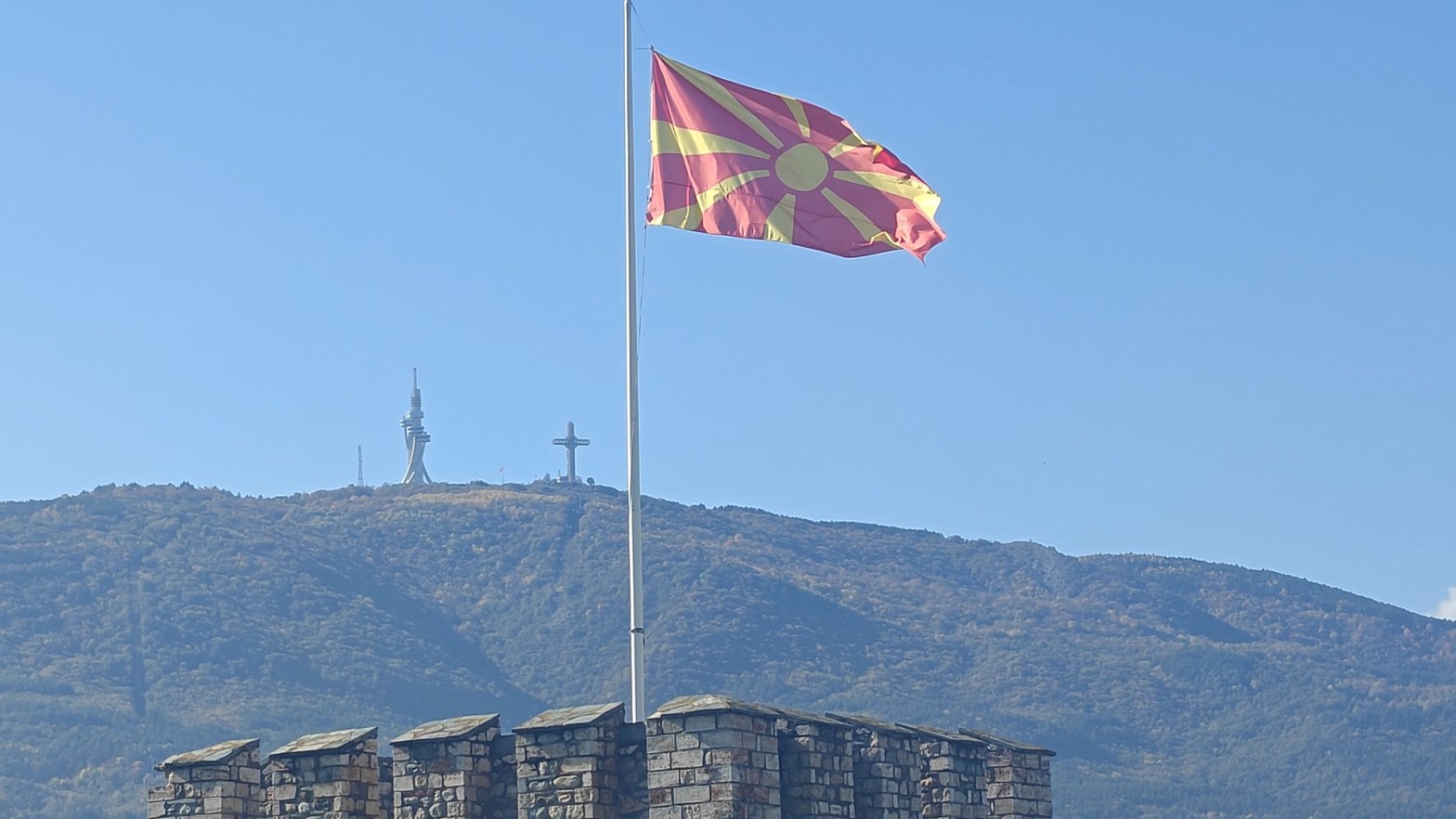
Our second destination was the Millennium Cross, which is a 66-meter-tall cross on a mountain next to Skopje. Built in 2002, it’s one of the tallest crosses in the world. It was constructed to serve as a memorial for 2,000 years of Christianity in Macedonia. Now it’s a landmark with the best observation point to see over the panorama of Skopje. It’s seen from everywhere…even from my apartment, and it’s well-lit even in the night. In order to get there, you need to drive first up the mountain. From the parking lot its just a few steps to the cable car station, which will take you the rest of the way. There were a lot of people at the top enjoying the view and walking around. There was almost no wind on top of the hill, so I had to wait for a long time to get the flag flying enough for a picture. But I wasn’t in any hurry because the cable cars had stopped working. They seem to work for 30 minutes and then rest for 30 minutes. So my timing had been very good.
After I got dropped off at my apartment, I had a chance to rest a bit, try the Wolt food deliveries (which were way quicker than I had expected), and after writing this bit here, I’m ready to go and find some live music tonight. I don’t know how many people there are out and about, as Skopje is a place where people come to work during the weekdays and then drive back home for the weekends. We’ll see.
P.S. It didn’t go that well. I had chosen an Irish pub on the riverside because many portals recommended it and because there was live music. It might have been my worst Irish pub experience so far. They didn’t have Guinness on the tab, but only in a can. Which wasn’t cold enough, and which they didn’t even bother to pour out for me. The music included some classical rock songs, which I didn’t get to hear much, because they started half an hour later than planned, and by that time I had run out of the “Guinness” and couldn’t stand a minute more inside the smoke (because people still smoke inside in Macedonia).
Saturday, October 25
I had two tours to look forward to. The first was a food tour starting at 11:30, so it was a chance to have lunch and explore the local food scene. It turned out to be a brand new tour, and I was officially the first paying customer. The tour started from a local farmers’ market with some bureks with cottage cheese and spinach. After that, we walked to the so-called bohemian quarter to visit a cafeana. These are local restaurants, where people like to hang out as long as they are not thrown out, basically. We had a selection of different vegetable spreads with white cheese and white bread. It was delicious. Our next stop was a rakija bar. Locals like their rakija after appetisers, so it was a good timing. The selection of different flavours is mindblowing. The guide had pre-selected a few combinations, so I had a chance to taste three different flavours. My favourite was the grape, which is the Macedonian speciality, but the plum and apricot were not bad either. From the bohemian quarter, we walked through the city park to the riverside and had some kebab sticks with onion and pita bread in a cafeana overlooking the river. The last stop was in the old town, where I had a chance to have a dessert in the form of an oversized macaron with crème filling. So in three hours, I had managed to have lunch and got to understand the people and city a little better.
My second tour started at 4:30 from the Macedonian square. It was a city walking tour that I originally planned to have the day before. I didn’t expect much, but got a show that was a perfect ending to my visit to Skopje. I think I have never grinned so much during a tour. The guide was full of facts, information and good humour. Plus, I really envied his voice. Not only was it strong enough to be heard over the street noise, but it was also probably heard one street over. He was obviously very intelligent, well-travelled and able to convey it in a clear way. Here are some things worth repeating. Macedonia and Skopje have been through a number of different kingdoms and empires. One of the longest influencers was the Ottomans. Skopje was destroyed many times during the last century. One of the most profound destructions took place in 1963, when an earthquake levelled pretty much the whole city. So everything you see in Skopje is built after that. The rebuilding was a great example of solidarity between the countries, which funded the building in the next few years. The locals know exactly what was built by the soviets, Americans, Bulgarians, designed by Japanese etc. And remember that it was the height of the Cold War back then. Then the Skopje 2014 project happened. It’s one of the most controversial things I have ever heard happening in a modern city. You can read more about it in Wikipedia (https://en.wikipedia.org/wiki/Skopje_2014), but in short, it was decided to give Skopje a more monumental and visually pleasing image. It cost 80 – 500 million euros to 1 billion euros (nobody knows). They built a countless number of statues (nobody knows how many, but people have been trying to count them and ended up with different numbers between 360 and 380), bridges over the river where you don’t really need them and covered the facades of some buildings with a facelift. It is now known that it was one big corruption case, which has resulted in crumbling buildings and rusted statues only a decade later. It’s what you can call kitsch with poor building quality, “marble” made of concrete and “bronze” made of some rusting metals. The locals are really unhappy with the result. The local municipality elections are ignored by the locals due to hopelessness; the streets during the elections are full of garbage due to some political games, and Macedonians have had to make several “compromises” with the Greeks in order to join NATO and be part of the EU one day. Because you can’t have any ongoing political disputes with your neighbouring countries, like Greece.

